In a new letter, advocacy groups are urging the US government to make an experimental Ebola treatment, Mapp Biopharmaceutical’s MBP134, available for trials and emergency use in countries affected by an ongoing Bundibugyo Ebola outbreak in the Democratic Republic of the Congo (DRC) and neighboring Uganda.
Public Citizen, Health Global Access Project, AVAC, Congregation of Our Lady of Charity of the Good Shepherd, Doctors for America, Evangelical Lutheran Church in America, and National Advocacy Center of the Sisters of the Good Shepherd sent the letter to the Biomedical Advanced Research and Development Authority (BARDA). BARDA and the United States developed the monoclonal antibody treatment to address Sudan strain of Ebola virus.
The monoclonal antibody “cocktail” has been investigated as a pan-ebolavirus therapeutic and was developed from antibodies taken from survivors of the 2014 West Africa outbreak.
The number of confirmed Ebola cases in the DRC and Uganda has increased to 856, including 198 deaths. Twenty-nine of the cases are new, as are four deaths.
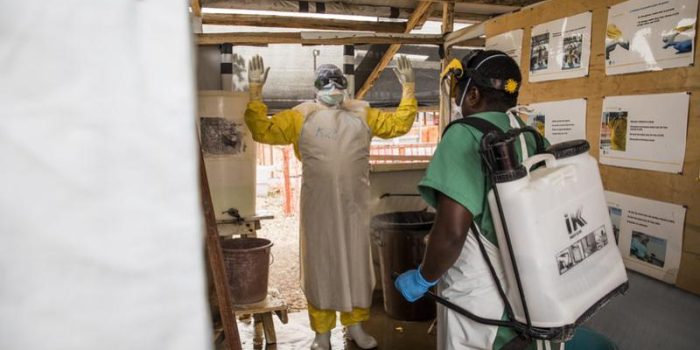
There are no current vaccines or treatments being used against the Bundibugyo strain, and efforts to practice contact tracing and isolation have failed to gain ground in North and South Kivu and Ituri provinces of the DRC.
Africa CDC warns of $21 million funding gap
Today on X, the Africa Centres for Disease Control and Prevention (Africa CDC) warned of a significant funding gap in the response effort, one month after the outbreak was officially recognized by the World Health Organization (WHO).
“This outbreak is not yet under control. Critical gaps remain in contact tracing, supplies, and a USD 21.5 million funding gap that must be urgently addressed,” Africa CDC said.
In a new situation report published yesterday by the WHO, the case-fatality rate in the DRC now stands at 23.8%. From June 7 to June 14, confirmed cases grew by 60%, and the number of affected health zones increased from 25 to 31, including 20 of 36 health zones in Ituri province, 10 of 34 in North Kivu province, and one of 34 in South Kivu province. Ituri is the epicenter of the outbreak, with 91.3% of cases and 79.7% of deaths.
North Kivu, however, has reported the highest case fatality ratio (56.7%), compared with 20.7% in Ituri and 33.3% in South Kivu.
“Transmission continues to be amplified by insecurity, high population mobility, and operational challenges in affected areas,” the WHO said. “Follow-up coverage remains particularly suboptimal in Ituri Province (64.2%) and North Kivu Province (56.4%), posing continued challenges to interruption of transmission chains.”
Officials have reported no new case in Uganda since June 5, suggesting the outbreak there is stable, with 19 confirmed cases, one probable case, and three deaths.