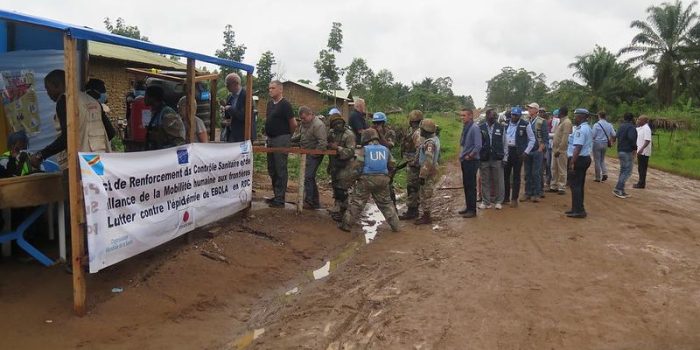
The Africa Centres for Disease Control and Prevention (Africa CDC) is urging member states to strengthen border exit screeningsin light of the growing Ebola outbreak in the Democratic Republic of the Congo (DRC).
Analysis from the Africa CDC Emergency Consultative Group (ECG), an independent advisory body to the Africa CDC, said the 11 countries most at risk for Ebola and those bordering the DRC should enhance surveillance but not institute travel bans.
Being prepared will reduce the risk of the virus spreading locally in the event of an imported case.
“Being prepared will reduce the risk of the virus spreading locally in the event of an imported case. Preparedness builds confidence in the local response and reduces community anxiety and concern that often follows the discovery of an imported case of Ebola disease,” said Salim Abdool Karim, MBChB, PhD, chair of the ECG, in an Africa CDC press release.
As of June 10 and 11, the US Centers for Disease Control and Prevention (US CDC) said the outbreak in the DRC and Uganda has grown to 695 confirmed cases, 138 deaths. All but 19 of those cases are from the DRC, where Ituri province is the epicenter of the outbreak.At least 23 people have recovered.
Europe, US pledge more money
The ECG formally supported the development of a diagnostic laboratory in Ituri and said there was an urgent need for Bundibugyo-specific rapid diagnostic tests to speed laboratory confirmation in affected and high-risk countries.
This is only the fourth documented Ebola outbreak caused by the Bundibugyo strain and one of the reasons transmission went undetected for weeks because tests were looking for only the Zaire Ebolavirus.
Earlier this week, Africa CDC received €11.5 million ($13.3 million) in a renewed commitment from the European Commission to support stronger preparedness and a coordinated response to the Ebola outbreak. Included is €5 million ($5.8 million) worth of testing equipment, including rapid diagnostic devices and lab test kits, to be deployed quickly where they are needed most.
Yesterday, the US Department of State announced an additional $20 million in funding to support comprehensive preparedness activities in countries surrounding the current outbreak, including Burundi, Kenya, Rwanda, and South Sudan.
Report details Uganda’s first case
In scientific developments, Nature Medicine has a case report onUganda’s index case of Bundibugyo Ebola.
The man traveled from the DRC to Uganda and was admitted to a private hospital in Kampala on May 11 after more than two weeks of vomiting and diarrhea. Upon hospitalization, he deteriorated quickly, developed multiorgan failure, and died on May 14.
Of the 19 cases in Uganda, 14 have been imported, and five have been among Ugandan nationals.
And new findings of a longitudinal study in Liberia indicate that Ebola is associated with neurologic complications in survivors, with increased healthcare burden and socioeconomic costs. The neurologic issues generally improved with time, but some were long-term. The study, published in JAMA Neurology, included 148 Ebola survivors and 81 controls.