After three weeks of declining cases, influenza levels rose this week and remain elevated across the United States, and respiratory syncytial virus (RSV) and COVID-19 activity is high in certain parts of the country, the Centers for Disease Control and Prevention (CDC) said in its weekly respiratory virus update and FluView report today.
Overall levels of acute respiratory illness are low to moderate in most of the country, with only Alabama and Arkansas in the high category. COVID-19 cases are unchanged since last week for much of the country, with levels growing or likely growing in 11 states. Flu cases are trending upward in 13 states, as are RSV cases in 21 states.
Eight more pediatric flu deaths
Influenza A rates have remained stable, while influenza B is gaining ground across the country. Of 692 influenza A(H3N2) viruses collected since September 28 that underwent additional genetic testing at CDC, 90.5% belonged to subclade K, a variant with mutations that have enabled it to evade immunity conferred by the current flu vaccine formula.
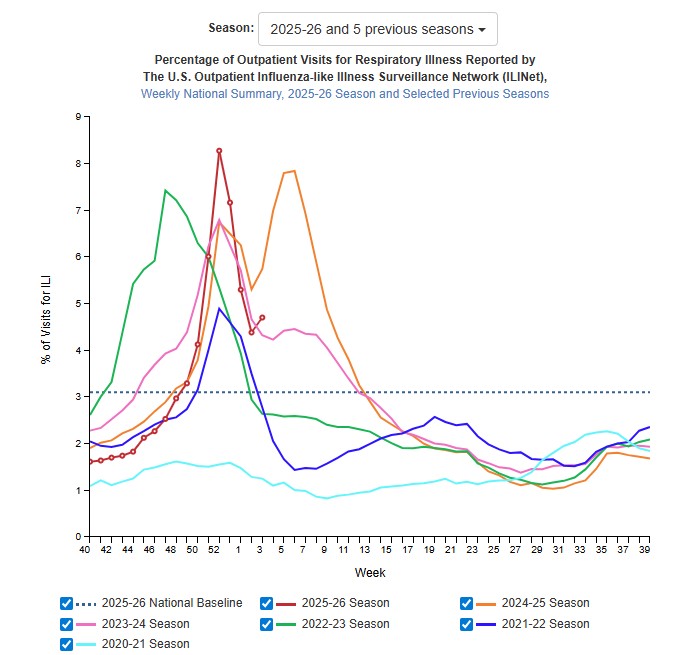
For the week ending January 24, 4.7% of health care visits were for respiratory illness, above baseline (see the CDC graph below). The flu hospitalization rate was 59.5 per 100,000 people, for a total of 15,080 admissions, part of a downward trend. Eight children died from flu, for a total of 52 pediatric deaths this season.
The proportions of positive tests were 5.3% for COVID-19, 6.3% for RSV, and 18.0% for flu, up from last week’s totals of 5.1%, 5.3%, and 17.2%, respectively. The percentages of emergency department (ED) visits were 0.7% for COVID-19, the same as last week; 3.4% for flu, up from 3.2% last week; and 0.5% for RSV, representing no change from last week.
ED visits, hospitalizations for RSV highest among infants
Although hospitalizations continue to trend downward overall, they are increasing among infants under age 1, and ED visits among children aged 5 to 17 years are climbing. For RSV, ED visits are highest among infants and preschoolers, and hospitalizations are highest for infants.
It is not too late to get vaccinated this season.
Wastewater concentrations are very high for COVID-19 in Connecticut, Iowa, Indiana, Maine, Michigan, Oklahoma, and South Dakota; for influenza A in South Dakota and Vermont; and for RSV in Maryland, Massachusetts, Louisiana, and Virginia.
The CDC noted that national COVID-19, flu, and RSV vaccine uptake is low for both adults and children. “COVID-19, influenza, and RSV vaccines can provide protection against severe disease this season,” the agency wrote. “It is not too late to get vaccinated this season.”