_0.jpg)
A January 2026 Pew Research Center survey of 5,111 US adults suggests that most Americans believe it’s important for the United States to be a world leader in science, but deep partisan differences exist in how Americans view the country’s global scientific standing and what role government should play in scientific research.
Most US adults agree that it is important for the United States to be a world leader in scientific achievement. More than half of both Republicans and Democrats say this goal is very important, and, overall, interest in the United States being a world leader in science has increased since 2023.
Changing attitudes since 2023
The public is divided on whether the United States is keeping pace with other countries in terms of scientific achievements. Roughly two-thirds of Democrats and those who lean Democratic (65%) say the United States is slipping behind other countries when it comes to science. That’s a 28-percentage point increase from two years ago, when Joe Biden was president.
Only about one-third of Republicans and those who lean Republican (32%) share that view, down 12 percentage points over the same period. Democrats are now 33 percentage points more likely than Republicans to say American science is falling behind. In 2023, this difference was inverted and much smaller: Democrats were 7 percentage points less likely to say America was losing ground in science.
Despite these different views, majorities of both parties believe government investment in science is worthwhile (84% overall), though Democrats (93%) are more likely than Republicans (76%) to say so. Republicans are also less likely to consider government investment essential, with 54% saying that private investment will ensure sufficient scientific progress.
Americans also differ in what they consider the strongest drivers of scientific progress. Democrats (71%) say colleges and universities are most likely to contribute a great deal or quite a bit to science. In contrast, Republicans (56%) say private companies contribute quite a bit to scientific progress.
The poll has a margin of error at the 95% confidence level of plus or minus 1.7 percentage points.

Two members of a panel that advises the federal government on vaccine injury compensation have been removed from the group before their terms had ended, according to media reports.
As first reported by Endpoint News, the two members of the Advisory Commission on Childhood Vaccines (ACCV) received emails earlier this week informing them that they had been removed from the panel. Statconfirmed the two members were Veronica McNally, JD, of Michigan State College of Law, and Wendy Lane, MD, MPH, of the University of Maryland School of Medicine.
A spokesperson for the Department of Health and Human Services (HHS) did not respond to a request for confirmation of the news.
Group could recommend expansion of compensable vaccine injuries
Housed within HHS, the ACCV reviews issues relating to the Vaccine Injury Compensation Program (VICP), established in 1986 to protect vaccine makers from most lawsuits alleging vaccine-related injury.
Under its charter, the panel advises HHS on the implementation of the VICP, including which vaccines should be included in the program, and can recommend changes to the Vaccine Injury Table, which lists vaccine-associated injuries or conditions that may be eligible for compensation under the VICP. It also directs research priorities related to vaccine injuries and surveys how adverse reaction data are gathered and used.
The ACCV charter includes three slots for lawyers, three for public health officials, and three for members of the public.
Since Robert F. Kennedy Jr. became HHS secretary, vaccine experts have been concerned that he might seek to use the group to make changes to the VICP that would expand the list of injuries or conditions eligible for compensation. “The VICP is broken, and I intend to fix it,” Kennedy said in post on X in July 2025.
Among the fears is that an expanded list of injuries associated with vaccines could bankrupt the VICP Trust Fund, which could force vaccine makers to leave the market.
ACCV recently met on December 29, 2025, the group’s first meeting since July 2024. It’s supposed to meet four times per year. Lane was at the meeting, which did not result in any actions taken, but McNally was unable to attend.

Seasonal flu activity in the United States remains high nationally but appears to be declining, according to an update from the Centers for Disease Control and Prevention (CDC).
The latest FluView report from the CDC shows several flu markers on the decline for the week ending January 10. Data from clinical laboratories nationwide show the percentage of flu-positive tests at 18.6%, down from 24.6% the previous week, while data from the National Healthcare Safety Network show the rate of hospitalizations for flu fell from 12.2 per 100,000 population to 8.4. The number of US jurisdictions reporting very high or high flu activity also fell from the previous week, from 45 to 36.
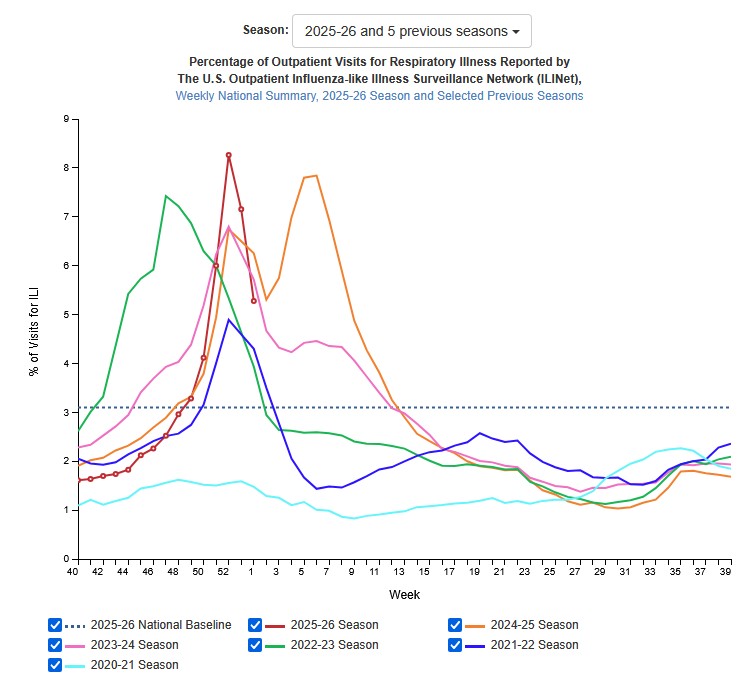
The percentage of outpatient visits for influenza-like illness fell from 7.2% to 5.3% but remained above the national baseline or the sixth consecutive week (see CDC graph below). The percentage of deaths due to flu (2.1%), however, was up slightly from the previous week.
One of the states where flu activity is picking up is California, which is seeing an increasing number of cases and hospitalizations, the California Department of Public Health (CDPH) reported earlier this week.
“It is important for families to know that flu vaccines, tests, and treatments remain widely available for all Californians and that it is not too late to get a flu vaccine,” CDPH Director and State Public Health Officer Erica Pan, MD, said in a news release.
It is not too late to get a flu vaccine.
Among the influenza A (H3N2) viruses that have been collected and undergone additional genetic testing, 90.9% belong to subclade K, the variant that has mutated to evade immunity from the current flu vaccine strain.
The CDC estimates there have been 18 million illnesses, 230,000 hospitalizations, and 9,300 deaths from flu this season. The deaths include 32 children, 90% of whom were not vaccinated. Fifteen of the deaths are new.
RSV elevated, COVID on the rise
The CDC’s weekly respiratory virus update, meanwhile, shows respiratory syncytial virus (RSV) activity is elevated in many parts of the country, with emergency department visits rising among young children (ages 0 to four) and hospitalizations up in infants under age one year.
COVID-19 levels are low but increasing nationally.
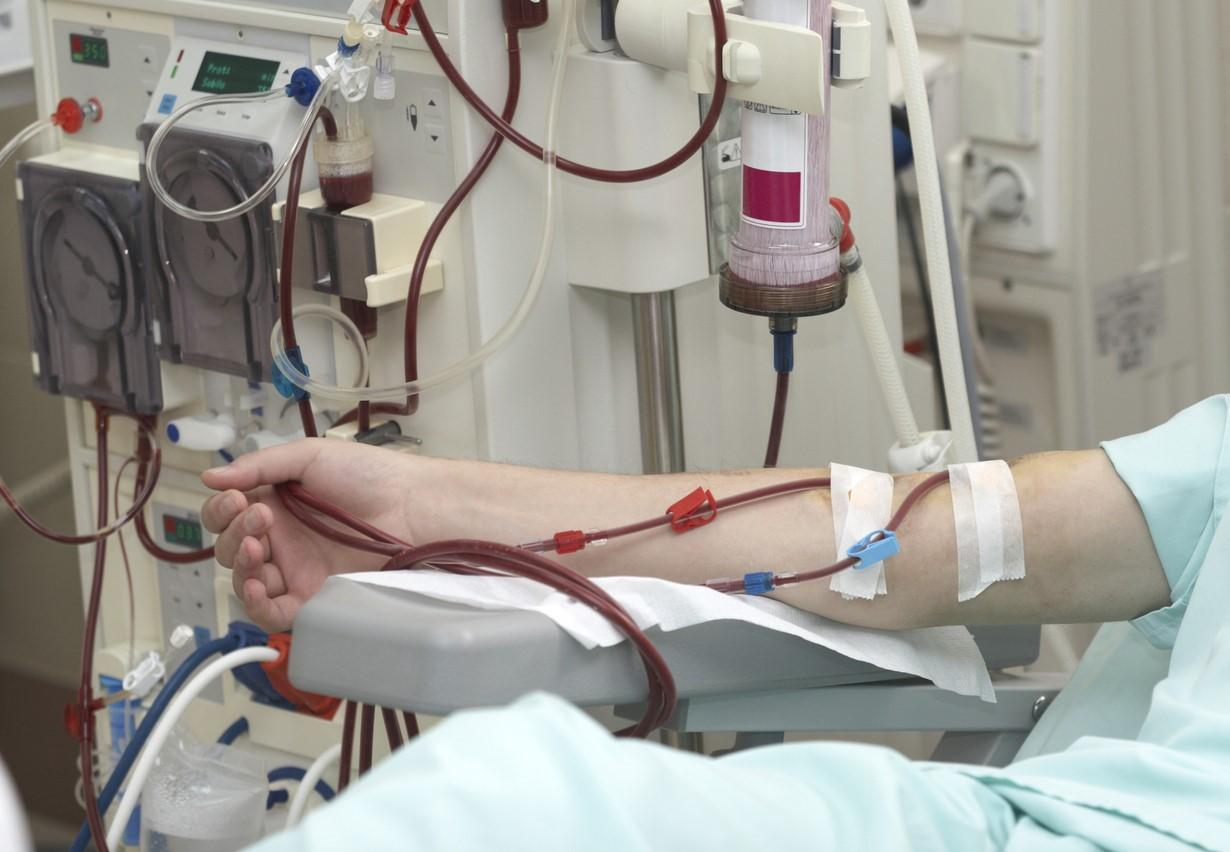
During the COVID-19 pandemic, US adults who received hemodialysis at outpatient centers had higher rates of SARS-CoV-2 infection than those receiving treatments at home, especially during case surges, suggests a study published in Infection Control & Hospital Epidemiology.
Investigators from the Centers for Disease Control and Prevention (CDC) examined rates of COVID-19 among patients at 7,974 dialysis facilities from January 2021 to May 2023 (Alpha-to-Omicron variant dominance). In 2021, 14.1% of US dialysis patients received at-home treatment.
Proximity to other patients, staff
COVID-19 infections totaled 171,338 (155,499 in-center and 15,839 home dialysis cases). The pooled average infection rate was highest during “[Alpha] B.1 and other” variant predominance (6.20 and 3.40 per 1,000 patient-weeks for in-center and home patients, respectively) and lowest during non-surge weeks (1.15 and 0.74 per 1,000 patient-weeks for in-center and home patients, respectively).
Ensuring patients receive education on the different dialysis modalities is critical to ensure they are able to make well-informed decisions regarding which modality is best for their lifestyle and health goals.
In-center hemodialysis patients had higher average infection rates than home dialysis patients (2.85 vs 1.69 per 1,000 patient-weeks, respectively).
During surges, the differences in case rates between in-center and home patients were more apparent than during non-surge weeks for all variant-dominated periods: B.1 and other (RRR, 1.11), Delta (relative rate ratio [RRR], 1.20), and Omicron (RRR, 1.07).
“Ensuring patients receive education on the different dialysis modalities is critical to ensure they are able to make well-informed decisions regarding which modality is best for their lifestyle and health goals,” the study authors wrote. “One potential benefit of home dialysis that could be discussed with patients is reduced exposure to communicable diseases.”
The differences in rates between in-center and home dialysis are likely due to several factors. “Patients receiving hemodialysis in outpatient centers spend hours in close proximity to other patients and facility staff members during treatment sessions,” the researchers wrote. “Social distancing may also be difficult for patients who rely on shared transportation to visit dialysis facilities.”