

Six more US children died of influenza last week as seasonal respiratory virus activity continues slowing, the Centers for Disease Control and Prevention (CDC) reported today in its weekly FluView report.
Pediatric flu deaths so far this season now total 149. About 85% of the children who died and had a known vaccination status were unvaccinated.
Wastewater RSV, influenza B, rotavirus high
Positivity for flu in clinical labs was 4.7%, down from 6.0% the week before. In total, 1.9% of visits to a health care provider were for respiratory disease, compared with 2.1% the previous week, and the hospitalization rate was 1.3 per 100,000 people, a shift downward from 3.4 the week before. Influenza B viruses remain predominant after surpassing influenza A viruses in recent weeks.
Of 2,302 influenza A viruses collected since September 28, 2025, that underwent additional genetic testing, 92.8% have belonged to subclade K, a variant tied to immune escape.
Thus far in 2026, the CDC estimates that there have been at least 31 million illnesses, 380,000 hospitalizations, and 23,000 deaths from flu.
Data from WastewaterSCAN shows that viral levels of measles, SARS-CoV-2, and influenza A in wastewater have been low for the past 10 days, but concentrations of respiratory syncytial virus (RSV), influenza B, human metapneumovirus, norovirus, and rotavirus are high.
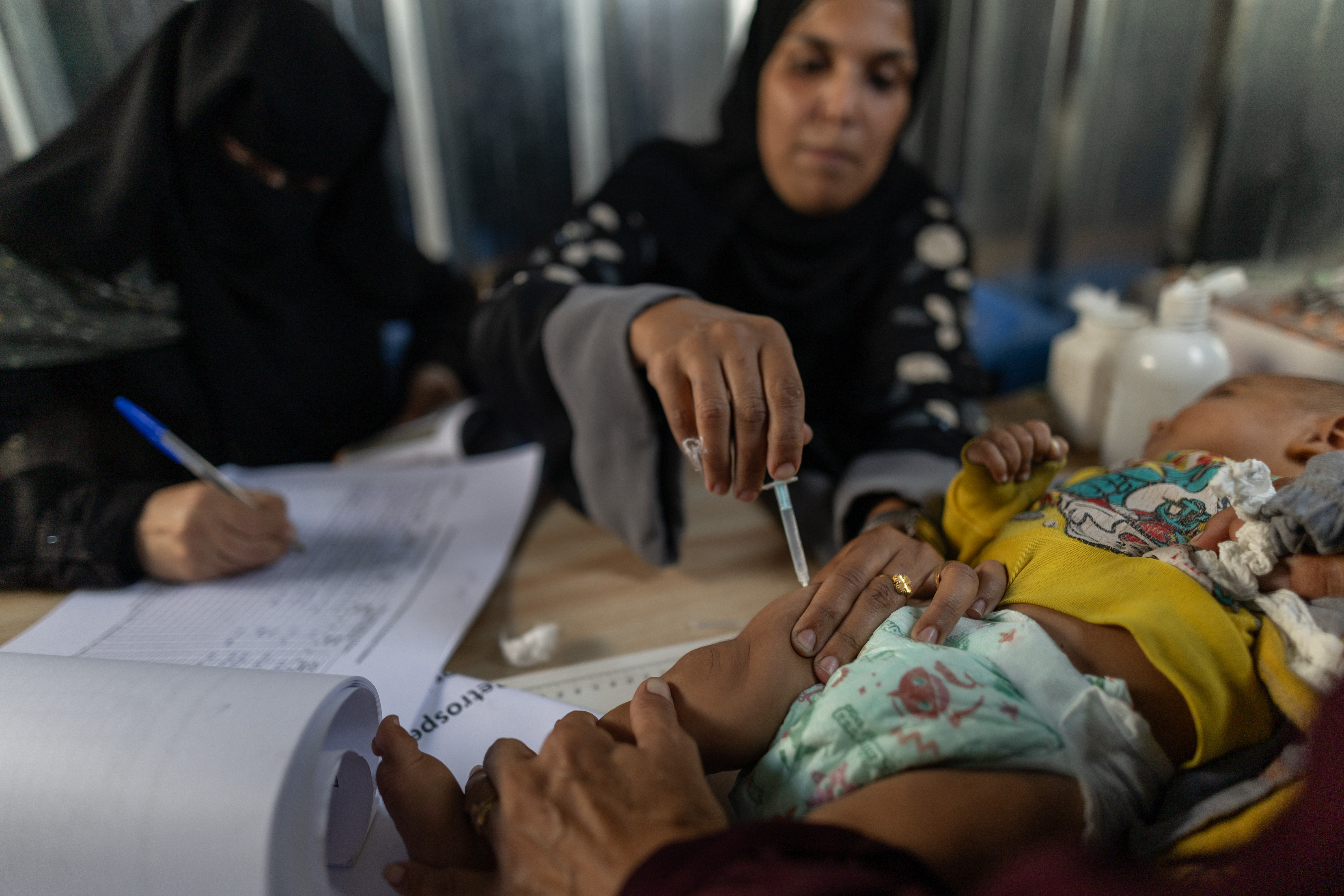
A multi-year effort to address global declines in childhood vaccination has delivered more than 100 million vaccine doses to more than 18 million children across Africa and Asia, the World Health Organization (WHO) announced today.
Initiated in 2023 by the WHO, UNICEF, and Gavi, the Vaccine Alliance, the “Big Catch-Up” is focused on closing the vaccine equity gap in children ages 1 to 5 in 36 countries. Of the 18.3 million who received vaccines from 2023 to 2025, 12.3 million had not yet received any vaccine, and 15 million had not received a measles vaccine, the WHO said.
Although millions of children in low-income countries miss out on vaccines every year, the problem was exacerbated by the COVID-19 pandemic, which disrupted national immunization programs and added millions more “zero-dose” children. The WHO said the initiative addressed this issue by leveraging routine immunization programs to reach 1- to 5-year-olds who had missed out on infant vaccines.
The participating countries also trained health workers to identify, screen, and vaccinate missed children as part of routine care.
Initiative on track to reach 21 million kids
The initiative concluded in March and is on track to meet its goal of catching up 21 million undervaccinated children, the WHO said.
“By protecting children who missed out on vaccinations because of disruptions to health services caused by COVID-19, the Big Catch-Up has helped to undo one of the pandemic’s major negative consequences,” WHO Director-General Tedros Adhanom Ghebreyesus, PhD, said in a press release. “The success of the Big Catch-Up is a testament to health workers and national immunization programmes, which are now better equipped to find and vaccinate children missed by routine services.”
But UNICEF Director Catherine Russell, JD, warned that many more children remain “out of reach.”
“The gains made through the Big Catch-Up must be sustained through investment in strong, reliable immunisation systems, especially at a time where measles is resurging,” she said.

Transmission of clade 1 mpox virus during commercial air travel appears to be uncommon, according to a study published yesterday in Morbidity and Mortality Weekly Report from the US Centers for Disease Control and Prevention (CDC).
The analysis looked at data from five commercial flights taken by three men with active mpox symptoms to assess the risk of in-flight transmission. The three men were aged 20 to 40 years. The flights took place from November 2024 to January 2025.
Among 60 identified contacts, defined as nearby passengers and crew, one person reported symptoms of fatigue, body aches, and a skin lesion after the flight, but that person tested negative for mpox. No secondary cases were identified.
Vaccination reduces transmission, severity
Mpox is an infectious disease that causes painful rashes and blisters, as well as flu-like symptoms. It is caused by the mpox virus, which is divided into different genetic groups, or clades. The virus is most commonly spread through close, prolonged physical contact.
Clade 2 mpox began spreading globally in 2022, and roughly 37,500 cases have since been reported in the United States, where transmission is still occurring.
Previous contact tracing has indicated that the risk of clade 2 mpox transmission during commercial air travel is low. But prior data suggested that clade 1, which began circulating in central Africa in 2023 and has resulted in roughly 150 travel-associated cases outside of Africa, might be more transmissible. The current investigation did not find evidence supporting the spread of clade 1 in an airline setting.
Based on these results, the CDC discontinued routine aircraft contact tracing for all mpox clades and subclades in 2025. But public health officials continue to recommend that people with mpox avoid travel until they have fully recovered. Vaccination of at-risk groups remains an important tool for reducing transmission and disease severity, the authors said.
- For the first time, investigators are conducting a clinical trial of the safety and dosing of a prion-disease drug candidate in people, the Broad Institute of MIT and Harvard announced yesterday. The phase 1 trial will enroll 15 symptomatic patients diagnosed as having a prion disease and 15 controls. The drug is a small interfering molecule that binds to and snips RNA molecules so that cells make less of the prion protein. Prion diseases are neurodegenerative disorders caused by the accumulation of misfolded prion protein in the brain. There are currently no cures, and the diseases are fatal within months or years after symptom onset. In a preprint study last month, the scientists showed that a single dose of the treatment reduced prion protein in mice by 49% and increased survival by 64%.
- Artemether-lumefantrine (Coartem Baby), the first malaria treatment for newborns and young infants, has been granted World Health Organization (WHO) prequalification, according to Novartis. The drug developer says it is making the treatment available primarily on a not-for-profit basis in areas endemic for the mosquito-borne illness. Known as Riamet Baby in some countries, Coartem Baby was developed in collaboration with the Medicines for Malaria Venture. Prequalification is a WHO process evaluating the quality, safety, and efficacy of treatments.
- This week, the Global Polio Eradication Initiative reported three circulating vaccine-derived poliovirus type 2 (cVDPV2) cases, one in the Democratic Republic of the Congo (DRC) and two in Sudan. The DRC case occurred in Maniema province, with onset of paralysis on February 14, 2026, for a total of four cases this year and six in 2025. The Sudan infections were reported in North Kordofan and Red Sea states, with paralysis onsets of November 8, 2025, and January 20, 2026, respectively. In 2025, 12 cVDPV2 cases were reported in Sudan, with one so far this year.
Extensively drug-resistant Shigella on the rise in US, CDC warns