
 Antibiotic Aftershocks
This is part 1 in a three-part series on potential harms from taking antibiotics for dental procedures. Parts 2 and 3 will publish tomorrow and Thursday. All will be available here.
Dentists wrote more than 2.3 million prescriptions last year for an antibiotic called clindamycin, whose label has carried a black box warning for more than four decades, due to its high rate of life-threatening complications.
One of those prescriptions was given to Dolores Hernandez Owens.
Owens, 92, lived with her husband of 45 years in a small yellow house with a white fence in southern California. She relished feeding the people she loved, preparing both the Mexican dishes on which she was raised, and the soul food her husband savored. She tended the flower garden and fruit trees in her yard, gathering armfuls of lemons, grapefruits, and figs as presents for her family.
Owens was also a woman of faith. Her favorite Gospel songs could inspire her to dance with joy, rocking from side to side, gently waving her arms and smiling.
One year ago, her dentist told Owens that she needed a tooth pulled. Owens took the news in stride, joking that she might have to chew with her front teeth from now on, said her son, Robert Flournoy. Her dentist prescribed clindamycin, the second-most commonly used drug in dentistry.
That’s when Owens’ life changed.
Within days of her surgery, Owens developed severe stomach pain, nausea, loss of appetite, headaches, and frequent, severe bouts of diarrhea, Flournoy said. She sought care at the local emergency department and was hospitalized for a week. Her doctors diagnosed her as having colitis, an inflammation of the colon, and sent her home with more antibiotics.
Although Owens’ symptoms improved at first, they returned with a vengeance after about a week. When Owens visited a second hospital a few weeks later, she learned her illness was caused by an infection with Clostridioides difficile, often called C difficile or C diff, a bacterium that releases toxins that can destroy the lining of the intestine.
Owens’ family wondered if her illness was caused by food poisoning, Flournoy said.
Neither Owens nor her family knew that C difficile infections are closely related to antibiotic use. More than half of people who developtheseinfections outside a hospital have taken antibiotics, research shows. Of those people, 15% were prescribed antibiotics because of a dental procedure.
“If we had known the side effects, we would have told her not to take it,” Flournoy said.
A dangerous trend
Although taking any antibiotic can lead to C difficile—which sickens half a million Americans a year and kills nearly 30,000—clindamycin has long been known to pose an especially high risk.
“Clindamycin is notorious for causing C diff infections,” said Amesh Adalja, MD, a senior scholar at the Johns Hopkins Center for Health Security and infectious disease specialist who has treated many patients with C difficile. Yet “clindamycin is one of the go-to antibiotics for dentists.”
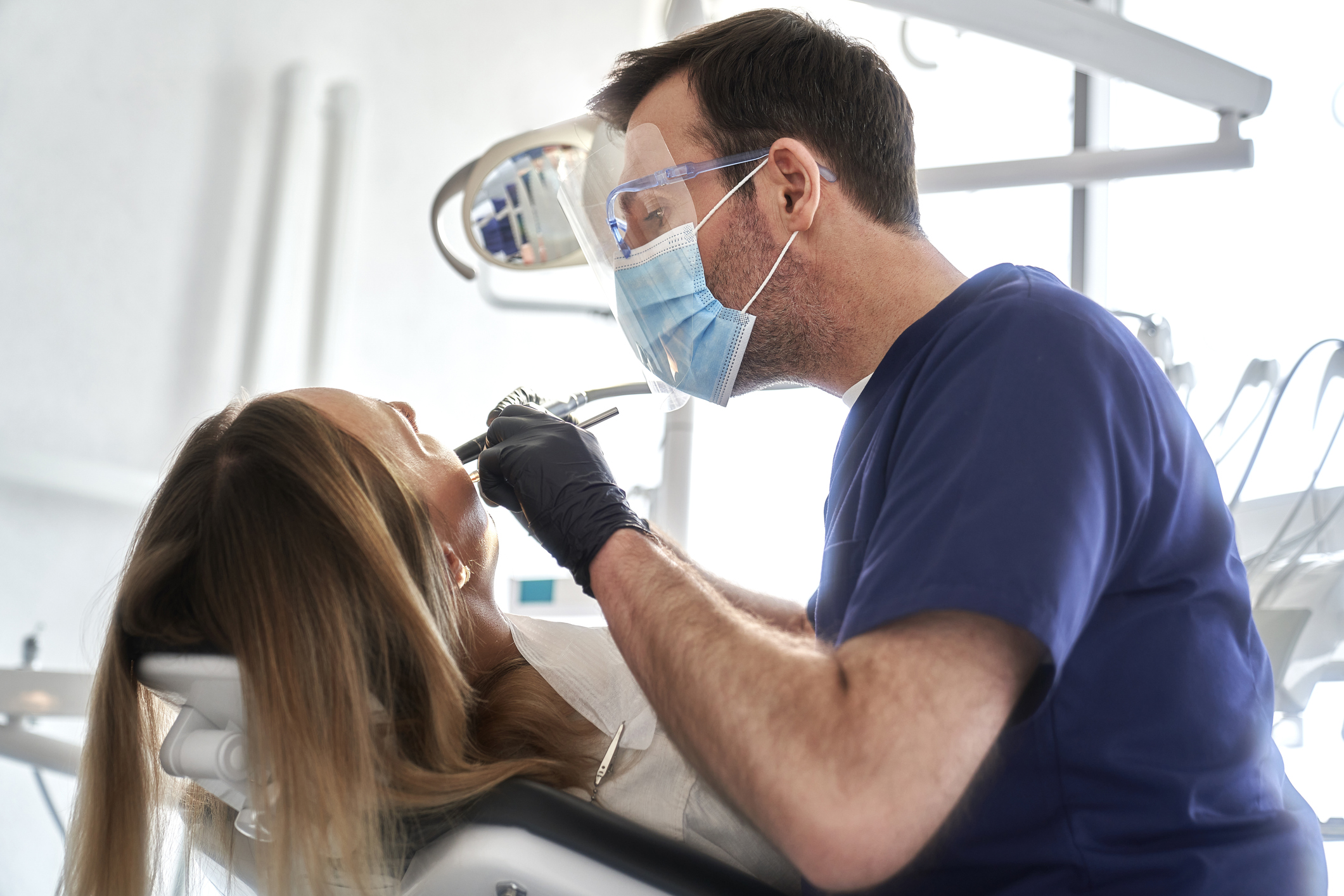
Many dentists prescribe antibiotics to healthy patients to prevent potential infections, in spite of research that finds 80% of these antibiotics are unnecessary. In addition to increasing the risk of C difficile infections, prescribing unnecessary antibiotics increases the risk of antimicrobial resistance (AMR), which has made antibiotics and other infection-fighting medications less effective. AMR contributes to an estimated 5 million deaths a year around the world.
For years, experts and professional societies have recommended that dentists tamp down their use of antibiotics—especially clindamycin—to reduce the risks to patients.
A CIDRAP News investigation found that the message isn’t getting through. In spite of repeated warnings about the risks, dentists continue to prescribe antibiotics in large numbers, often inappropriately.
Instead of declining, antibiotic prescribing by dentists increased by 6% from 2020 to 2025, when the profession wrote more than 27 million antibiotic prescriptions, according to data provided exclusively to CIDRAP News from IQVIA Institute for Human Data Science, an organization based in Parsippany, New Jersey, that provides research and analysis on health care data.
Although dental prescriptions for clindamycin decreased 35% from 2020 to 2025, it remains the profession’s second-most commonly prescribed antibiotic, according to IQVIA’s National Prescription Audit, which includes prescriptions provided at retail stores, by mail, and at pharmacies serving residents in long-term care facilities.
The data suggest that “antibiotics are massively overprescribed in dentistry,” Adalja said. The decline in clindamycin use “isn’t enough,” considering its life-threatening risks, he said. “Dentists are still using it too much.”
Elliot Abt, DDS, who co-wrote antibiotic guidelines for the American Dental Association (ADA), said he’s disappointed that clindamycin is prescribed more often than all but one antibiotic.
“I would have liked to see it at or near the bottom of the list,” said Abt, adjunct associate professor of oral medicine at the University of Illinois College of Dentistry. “Changing practitioners’ behavior is a slow and challenging process.”
.jpg)
A heartbreaking physical decline
C difficile ravaged Owens’ small body.
Owens developed sepsis, a life-threatening complication of C difficile in which the immune system overreacts to infection in a way that damages multiple organs.
She bled internally, losing so much blood that her doctor ordered a transfusion, Flournoy said. She became so dehydrated, weak, and light-headed that she tumbled off the toilet in her room, badly bruising her knee.
Unrestricted financial support provided by