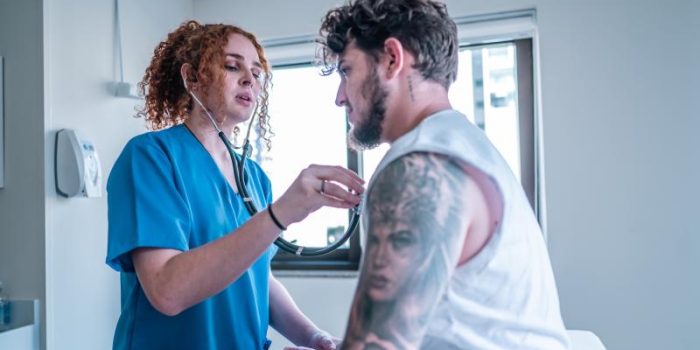
Carsen Rhys Beckwith has had a complicated relationship with their body.
As a teenager, they were horrified when they developed the curves typically associated with a female body. Beckwith didn’t want to be perceived as a woman; they wanted to present themself as masculine.
The anxiety caused Beckwith, who identifies as transmasculine and nonbinary, to develop a serious eating disorder that threatened their health.
Beckwith became more comfortable with their body after high school, when they found people who supported them, as well as medical care that helped them feel like their true self.
Today, at 29, Beckwith works at a center for people with eating disorders, and focuses on developing healthy habits.
That includes being screened for cervical cancer, something that many gender-diverse people avoid or can’t access.
“I know I need to take care of my health,” said Beckwith, who credits their experience in the health field with helping them feel more comfortable seeking medical care. “I know how to advocate for myself.”
Increasing awareness
Many gender-diverse people aren’t aware that they need to get screened for cervical cancer.
Most public health information about cervical cancer is geared toward cisgender women, or those who are content to have been labeled female at birth. That focus can lead gender-diverse people to miss out on the essentials:
- Nearly all cervical cancers are caused by the human papillomavirus (HPV), a ubiquitous virus that spreads through intimate skin-to-skin contact, including oral sex and deep kissing.
- People can be exposed to the virus even if they do not have intercourse. Condoms can reduce but not eliminate the risk of HPV, which causes a total of six types of cancer, including tumors of the anus, head and neck, penis, vagina, and vulva.
- Vaccination can prevent nearly all cervical cancers. Screening exams can detect cervical cancers early enough to be cured. Detecting and treating precancerous lesions can prevent cancer entirely.
“Everyone who has a cervix is at risk, even if they transition,” said Isabel Scarinci, PhD, MPH, vice chair for global and rural health in the University of Alabama at Birmingham’s obstetrics and gynecology department, who co-leads the state’s cervical cancer elimination program.
Yet cancer screening rates are much lower among gender-diverse people than others, said Patrick Eucalitto, MD, an assistant professor of obstetrics and gynecology and women’s health at Montefiore Einstein Medical Center in New York.
One study found that only 64% of transmasculine and non-binary people were up to date on cervical cancer screening, compared with 74% of other people. Gender-diverse people are more likely than others to be diagnosed as having cervical precancers, research shows.
Missing routine screenings puts people at higher risk. A study of people with cervical cancer found that 60% had not been screened as recommended before their diagnosis.
The American Cancer Society projects that nearly 13,500 Americans will be diagnosed with cervical cancer this year, and that 4,200 will die.
“We’re missing a lot of opportunities for cervical cancer screening in LGBT [lesbian, gay, bisexual, and transgender] populations,” Eucalitto said.
Putting people at ease
Kanthi Dhaduvai, MD, who provides gender-affirming care to adults in Florida, said she tries to educate patients about cancer screening. She tells them that guidelines for cervical cancer screening in gender-diverse adults are the same as for other patients.
But Dhaduvai knows that cervical cancer screenings, which can involve a pelvic exam, can be especially stressful for gender-diverse people.
Simply being reminded that they have a cervix can make some people anxious, a type of distress called gender dysphoria, which people may feel when their bodies don’t reflect the gender with which they identify.
The prospect of undergoing a pelvic exam, in which a clinician uses a device called a speculum to provide a better view of the cervix, can be terrifying for some people, especially if they have experienced trauma, said Mark Einstein, MD, chair of obstetrics and gynecology and women’s health at Montefiore Einstein.
Just talking about such an exam, Einstein said, has left some of his patients “quivering in the chair.”
Many lack experience in gender-diverse care
People who are gender-diverse may avoid cancer screening for multiple reasons. Many feel unwelcome in healthcare facilities. Research shows that half of gender-diverse people say they have been mistreated by a healthcare provider.
Even compassionate healthcare providers may know very little about what it means to be gender diverse, partly because doctors receive little training on the subject. Beckwith said they have often had to educate their doctors about the basics.
“An important part of these types of screenings is asking queer and trans folks what language they want to use to refer to their bodies,” Beckwith said. When clinicians don’t ask those types of questions, “that is what can turn people off from wanting to get that screening.”
Some hospitals are working to create a more welcoming environment for gender-diverse people. Montefiore provides gender-sensitivity training for staff, Einstein said.
Beckwith, who lives in Missouri, said it took time to find a transgender doctor who understands their health needs. The only problem? The doctor works at a women’s clinic.
“You have to walk into a room full of women and walk up to a receptionist and say, ‘Hi, I’m here for my appointment at the women’s clinic,’” said Beckwith, who wears masculine clothes. “They kind of give you the side eye. I have to say, ‘No, I promise. I’m supposed to be here.’”
Special issues for people taking hormones
Cervical cancer screenings can also be more uncomfortable and less accurate for gender-diverse people, who take testosterone.
Testosterone can give people a deeper voice, larger muscles, and facial hair. But testosterone can also lead to vaginal atrophy, which occurs when the walls of the vagina become thin, dry, and even inflamed, said Dhaduvai, a family medicine provider and fellow with Physicians for Reproductive Health. That can make pelvic exams much more painful.
Reducing discomfort during cervical cancer screenings is important, because research shows that people who experience pain are less likely to return for future screenings.
Testosterone also can cause changes in the cervix that make it difficult for clinicians to obtain usable samples for Pap tests, which involve looking at cells under a microscope. In one study, gender-diverse patients taking testosterone were 10 times more likely to have an inadequate Pap test result than other patients. Although people with inadequate results need to undergo a second screening, the study found that gender-diverse people were less likely to return to the clinic than cisgender women were.
Beckwith, who has taken testosterone for 10 years, said their doctor prescribed a topical estrogen for the week before one of their pelvic exams, in an effort to make the procedure more comfortable. Beckwith noted that some gender-diverse people, especially those who use testosterone to appear more masculine, may not be eager to use estrogen.
Dhaduvai tries to make screening more comfortable by talking patients through it and using a smaller speculum, such as the kind used in children. People can also opt to be sedated during pelvic exams, she said.
Dhaduvai said that persuading patients to be screened for cervical cancer can take time.
“I check in with them about screening every time I see them,” she said. “Even if they’re not ready the first time we talk about it, maybe in a couple months or a year they’ll be more willing to schedule the appointment.”
Allowing people to collect their own samples
Self-screening kits could encourage more people to undergo cervical cancer screening, Einstein said.
In January, the Department of Health and Human Services issued cervical cancer screening guidelines that, for the first time, included self collection as an alternative to traditional pelvic exams.
Self collection can be performed in a medical provider’s office or at home. Self-testing kits work much like the home tests for COVID-19 or the flu, except that swabs must be sent to a lab for analysis. These kits could be a good choice for gender-diverse patients, as well as people who have undergone trauma or anyone for whom a traditional Pap test could cause distress, Einstein said.
Studies show that most gender-diverse people prefer to collect their own sample. Research has found that offering this option can boost screening rates among gender-diverse people and others. But self-collection kits aren’t yet offered in all clinics.
When follow-up is necessary
Experts recommend regular cervical cancer screenings every three to five years, depending on the type of test used, even for people who have been vaccinated against HPV. While some experts recommend beginning screening at age 21, others suggest beginning at 25.
If screenings produce abnormal or inconclusive results, clinicians suggest follow-up procedures to produce definitive answers. In some cases, a clinician may recommend repeating the Pap test in six to 12 months, Dhaduvai said.
In other cases, healthcare professionals recommend colposcopies, in which clinicians use a tool with a bright light that works like a microscope to provide a better view of the cervix, Dhaduvai said. If needed, clinicians can perform a biopsy, in which they surgically remove a tissue sample for additional testing.
While many clinicians suggest that people take an over-the-counter pain reliever before a colposcopy, Dhaduvai said she is also sometimes willing to prescribe an anti-anxiety medication or offer sedation.
Beckwith has undergone six procedures related to cervical cancer prevention, including two painful colposcopies, with no sedation or anti-anxiety medication.
Because of inconclusive results, “I’ve had to do a number of repeats and go back in multiple times,” Beckwith said.
Beckwith said their first colposcopy was “a horrible experience.” The clinic invited student doctors into the room to give them the opportunity to observe the procedure in a transmasculine person. “I felt like a guinea pig,” Beckwith said.
“The second time, I went in a little bit more prepared,” Beckwith said. “I brought some great friends with me and a patient advocate” for support.
Beckwith said they were relieved that both test results were negative for cancer, which gave them peace of mind.
Beckwish said they hope more LGBTQ people take cancer prevention seriously.
“We focus on a lot of health concerns that are specific to queer people,” Beckwith said, “but we can always do with more focus on general prevention, screenings, and care for queer people, too.”