Five more children died of influenza in the United States last week, for a season total of 71, as viral activity stays high across much of the nation, the Centers for Disease Control and Prevention (CDC) reported today in its weekly FluView update.
The 2024-25 flu season saw a total of 289 child deaths—the most reported in a non-pandemic flu season since the CDC began tracking pediatric flu deaths in 2004.
Nine states are seeing moderate flu activity, while 26 report high or very high case rates. Flu test positivity continues to climb, reaching 19.8%, up from 18.6% the week before. Related hospitalizations also trended upward to total 14,940 for the week, at a rate of 70.2 per 100,000, up from 67.0 per 100,000 the previous week.
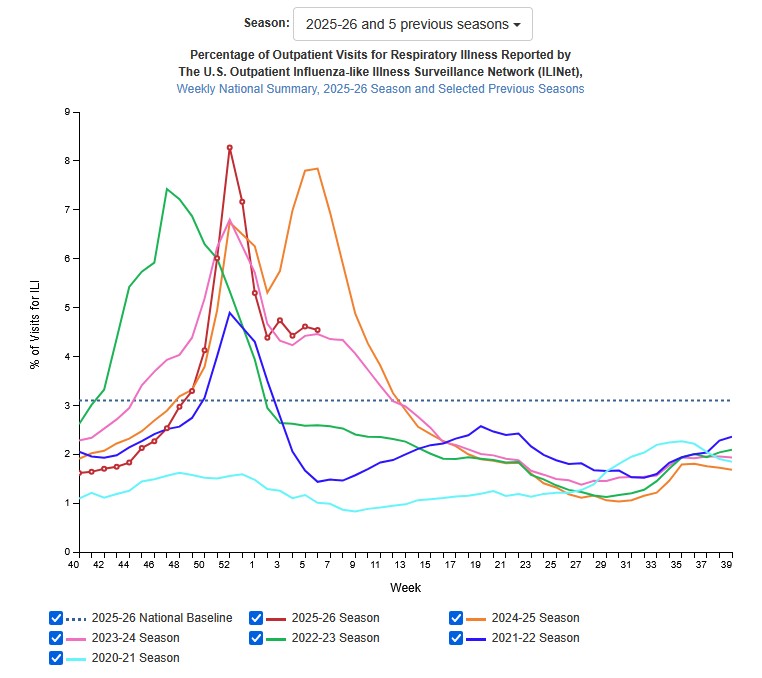
The percent of outpatient visits for respiratory illness was 4.5%, down slightly from 4.6% the week before but well above the epidemic threshold of 3.1%. The percentage has stayed relatively stable for 5 weeks now, varying from 4.4% to 4.7% (see the ride line on the CDC graph below).
Emergency department (ED) visits are highest among children aged 5 to 17, while people aged 65 and older have the highest hospitalization rates.
Influenza A continues to dominate, at 54.6%, but influenza B is rising (45.4%) in most areas of the country. Of 1,193 influenza A(H3N2) viruses that underwent additional genetic characterization since September 28, 2025, 92.1% were subclade K. That variant has mutations that enable it to evade immunity from this season’s flu vaccine formula.
So far this season, the CDC estimates that there have been at least 24 million flu-related illnesses, 310,000 hospitalizations, and 20,000 deaths. Ninety percent of people who died weren’t fully vaccinated
RSV ED visits moderate, growing in much of the country
Overall, rates of acute respiratory illness are moderate except for in Alabama, which is reporting a high number of cases. COVID-19 activity is declining in most areas of the country, with ED visits highest among infants and hospitalizations low across all age-groups.
Respiratory syncytial virus (RSV) incidence is still high in many regions. Related ED visits are moderate and growing or likely growing in much of the country, with ED visits and hospital admissions highest among infants and children aged 4 years and younger, followed by adults 65 and older.
Community wastewater levels are moderate for SARS-CoV-2 and RSV and low for influenza, according to CDC data, but WastewaterSCAN is reporting high concentrations of SARS-CoV-2, influenza A and B, RSV, and human metapneumovirus (HMPV), with low levels of enterovirus D68.
Vaccination rates remain suboptimal for COVID-19, influenza, and RSV. In total, 8.8% of children and 17.6% of adults have received the 2025-26 COVID-19 vaccine, with 33.7% of adults aged 65 and older immunized. The proportion of people receiving the flu vaccine is 48.2% for children and 46.5% for adults, including 68.7% of older adults. Of adults aged 75 years and older, 43.9% reporting ever receiving an RSV vaccine.