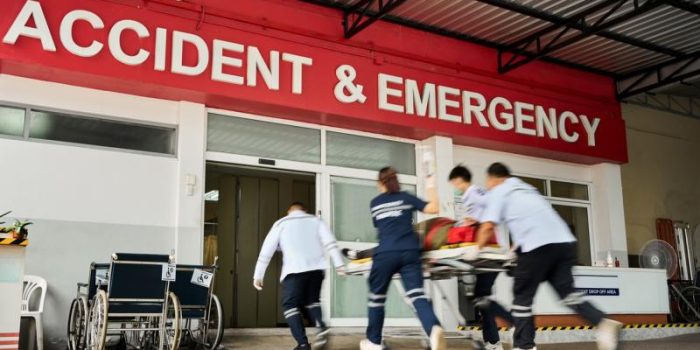
Tina Ridler has been living with long COVID since 2020. The condition has sent her to the hospital many times, including a trip to the emergency department to treat a life-threatening blood clot.
Until now, Ridler has never been afraid to seek medical care.
Ridler, 60, is delaying health appointments at the Mayo Clinic in Rochester, Minnesota, for fear of crossing paths with agents from Immigration and Custom Enforcement (ICE), who are conducting raids and arrests near the hospital. Although Ridler is a US citizen who was born in this country, she said she worries about being stopped in her car, hassled by ICE agents, or caught up in the crossfire.
“You would think a major medical center would be a safe space,” Ridler said. “I’m holding off making the appointments, because I don’t want to go into territory where ICE is operating.”
Missed opportunities to treat, prevent illness
During a severe flu season that has already killed 32 children, ICE raids are leading a growing number of people across Minnesota to cancel important and even life-saving medical appointments, said Janna Gewirtz O’Brien, MD, MPH, president-elect of the Minnesota Chapter of the American Academy of Pediatrics.
“There have been many reports of ICE entering hospitals and surrounding hospitals, and I think families are rightfully concerned that an encounter on their way to health care or within a health care setting could result in them being detained,” O’Brien said.
One Minnesota child suffered a severe case of appendicitis because his family waited too long to bring him to their doctors, said O’Brien, who is in touch with a network of physicians across the state. “There are frequently messages asking if anyone will do home visits. or come and see babies with respiratory distress so that they don’t have to come into the hospital,” O’Brien said.
The problem is getting worse, said Michelle Gross, a resident of North Minneapolis and president of Communities United Against Police Brutality, an advocacy group.
Families are rightfully concerned that an encounter on their way to health care or within a health care setting could result in them being detained.
When ICE first arrived in Minneapolis, volunteers drove immigrants and others to their medical appointments, Gross said. “Now that ICE has shown up at some of the hospitals and clinics, people are forgoing health care altogether,” she said.
“Our neighborhood sounds like a war zone right now,” Gross said. “The federal government has literally declared a war on our community.”
While ICE has been in the state since early December, its presence has grown dramatically since the beginning of the year. On January 6, Department of Homeland Security Secretary Kristi Noem announced that 2,000 ICE officers had been sent to the state. Earlier this week, she announced that “hundreds more” could be on the way.
ICE did not respond to an emailed request for comment before deadline.
With so many families canceling pediatric appointments, O’Brien said, “we are missing opportunities to prevent illness, vaccine-preventable illness in particular, and also to provide much-needed life-saving care.”
Health providers in Minnesota are looking for ways to see more children.
Hennepin Healthcare is expanding its use of telehealth “for our patients who may have challenges accessing care during this time,” spokeswoman Christine Hill said.
Its pediatric mobile health clinic, launched during the COVID-19 pandemic, has added additional appointments, Hill said. The health van can provide vaccinations and well child visits, said O’Brien, who hopes the service will begin treating acute illness, as well.
“Our healthcare community is amazing and is mobilizing and is looking to meet these needs as quickly as we can,” O’Brien said.
A national trend
Health care providers in other cities targeted by ICE have also reported fewer patients visiting their clinics for care.
About 84% of 691 health care providers in 30 states report significant or moderate decreases in patient visits since January 2025, when President Trump issued an executive order on immigration, according to a survey published by Physicians for Human Rights (PHR) and Migrant Clinicians Network (MCN) in November.
Children are showing up at hospital emergency rooms unaccompanied, according to the national survey. Health care workers are seeing kids as young as 6 years old with anxiety due to fears of family separation, the survey found.
“We are witnessing the creation of a generation with preventable trauma, delayed diagnoses, foregone treatments, and compromised development,” said Katherine Peeler, MD, a pediatrician and medical advisor to Physicians for Human Rights, in a written statement. “What we are documenting is systemic, orchestrated harm to immigrants, and therefore their children.
“Parents are making impossible choices: declining surgery for their children, delaying emergency care, and refusing specialty referrals because they have calculated that the risks of deportation or family separation exceed the medical necessity,” Peeler wrote.
US citizens afraid of being detained
A Rochester mother of nine children said she canceled two routine checkups for her newborn, born January 2, for fear of being detained by ICE on the way to the doctor’s office. Her doctor finally persuaded her to bring the baby into the clinic for to be weighed and have his heart checked.
The mother, 32, who asked CIDRAP News to refer to her by her nickname, Mawe, to protect her family, said she was born in Texas and is a US citizen. She’s afraid of being detained simply because she is Hispanic.
“I’ve seen ICE pick up citizens even with papers, people from in the USA who have no reason to be picked up and jailed,” Mawe said. “It’s been very dangerous out there.”
Like many Twin Cities residents fearful of ICE, Mawe said she rarely leaves home. Ridler and other volunteers bring groceries to her family.
Fear of ICE is harming not just individuals, but the state’s public health, said Tyler Pyle, MPH, president of the Minnesota Public Health Association.
“The unhealthy occupation of Minnesota by ICE agents, instilling fear in people who are already putting themselves forward to go to work, school, raise and/or be with families, and be part of Minnesotan life, is having negative impacts to our public health and people,” Pyle said.
I’ve seen ICE pick up citizens even with papers, people from in the USA who have no reason to be picked up and jailed.
Mawe is delaying her own medical care, including seeing a dentist for a painful cracked tooth. She also wants to see her doctor about persistent headaches and a birth control implant, but doesn’t know when she will feel safe to leave her home.
“Every time you step out the door, you take a risk,” Mawe said. “I’m worried it’s going to get worse.”
Seeing therapists and doctors by telehealth
DE, a physician from Egypt who asked to be identified by her initials to avoid being targeted, said she has barely left her home this month.
Although DE is a legal resident with a green card, she said she ventured outside just once since Renee Good, a 37-year-old mother of three, was shot and killed by ICE in Minneapolis on January 7.
“What makes me nervous is how I look,” said DE, who lives in Rochester. “The dark hair, the accent. That’s what they’re looking for, right? I’m afraid I would be approached because my skin is not white.
“Even if it’s just a question – ‘Where were you born? Or ‘What’s your ID?’, it’s scary, because I don’t know what the next step will be.”
Although DE said she is delaying getting lab tests, she has been able to meet with her therapist and internal medicine specialist though telehealth.
DE has been unable to work while isolating. Although her therapist is available by telehealth, DE said her loss of income may make it impossible to afford weekly sessions.
“What scares me most is not even just the interaction” with ICE, but “the helplessness,” she said. “Feeling so overpowered. And who would I turn to?”