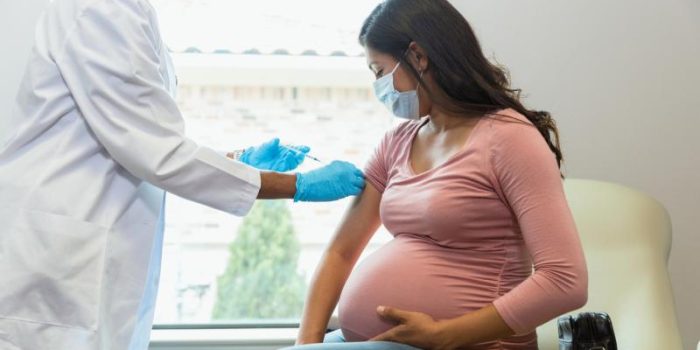
Pregnant women who develop COVID-19 after being vaccinated are much less likely to be hospitalized, need intensive care, or deliver early compared with women who aren’t vaccinated, a study today shows.
Canadian researchers who examined the medical records of nearly 20,000 women who developed COVID-19 while pregnant, found that vaccinated women were 62% less likely to be hospitalized than unvaccinated women and 90% less likely to need critical care, according to the study, published in JAMA.
The study confirms the safety and benefits of COVID vaccines for pregnant women demonstrated in earlier publicationsat a time when federal officials are publicly raising doubts about the safety of immunizations.
“This is another very strong study supporting the importance of vaccinating pregnant people for COVID-19,” said Demetre Daskalakis, MD, the former director of the Centers for Disease Control and Prevention’s (CDC’s) National Center for Immunization and Respiratory Diseases, who was not involved with the new study.
36% less likely to deliver pre-term during Omicron
Research has long shown that pregnant women face a high risk of becoming seriously ill and delivering early if they are infected with COVID-19, especially closer to delivery.
In the study, babies of vaccinated moms were less likely to require neonatal intensive care than the newborns of unvaccinated women. Rates of stillbirth were the same among vaccinated and unvaccinated women, although women who received COVID-19 shots were less likely to miscarry.
The study, which includes COVID-19 cases from April 2021 to December 2022, found different levels of preterm birth, depending on the dominant strain of the SARS-CoV-2 virus.
During the Delta wave, which began surging during the spring of 2021, vaccinated pregnant women with COVID-19 infections were 20% less likely to deliver prematurely than unvaccinated women with the illness.
The benefits of COVID-19 shots were even greater during the Omicron wave, which began to hit Canada in December 2021, when vaccinated women were 36% less likely to deliver pre-term.
Although the study authors followed up women in the study only through 2023, its findings remain relevant, because the viral strains circulating today are all “Omicron lineage viruses,” Daskalakis said.
Preventing pre-term birth reduces risk to babies
Being born too early “can have severe and lifelong impacts for the infant,” said Elisabeth McClymont, PhD, first author of the study and an assistant professor in obstetrics and gynecology and pediatrics at the University of British Columbia.
A typical pregnancy lasts about 40 weeks.
In the short term, babies born before 37 weeks are more likely to have trouble breathing on their own and to suffer from bleeding in the brain, intestinal inflammation, blood infections, heart problems, eye issues that can require surgery, and other serious risks.
Premature babies are also more likely to face challenges during childhood, such as cerebral palsy, hearing and vision problems, learning disabilities, poor growth, and problems with communication or social development.
Although vaccines do not cause autism, research shows that babies born pre-term are more likely to be diagnosed as having autism.
Among pregnant women who were vaccinated against COVID-19, rates of premature delivery were lower among those who were immunized during pregnancy than before, researchers found.
That doesn’t mean that women should wait until they’re pregnant to be vaccinated, said Kevin Ault, MD, a professor of obstetrics and gynecology at the Western Michigan University Homer Stryker School of Medicine who was not involved with the new study.
Ault recommends women get a COVID-19 shot “as soon as you think about conceiving,” rather than waiting for a positive pregnancy test. That’s because women could be infected with the virus before they know they are pregnant, which could endanger women and their pregnancies.
“If you have not received a COVID-19 vaccine recently and become pregnant, we recommend getting a dose in pregnancy,” said Deborah Money, MD, senior author of the study and professor of obstetrics and gynecology at the University of British Columbia.
“It is safe and will confer protection not only to you, but also to your infant.”
Demonstrated safety and effectiveness
Many studies have found COVID-19 vaccines to be safe and effective.
Researchers have estimated that COVID-19 shots saved 2.5 million to 20 million lives. Recent studies have confirmed the benefits of COVID-19 vaccinations:
- A US modeling study published in September in JAMA Pediatrics estimates that vaccinating pregnant women against COVID-19 prevented 7,000 hospitalizations in infants and 3,000 in pregnant women from January 2024 to May 2025.
- Earlier this month, a study from France found that vaccinated adults had a 74% lower risk of death from severe COVID-19 than unvaccinated people.
- And a CDC study last week found children aged nine months to four years who received COVID-19 shots in 2024-2025 were 76% less likely to visit an emergency room (ER) or urgent care because of COVID-19 than unvaccinated kids. Children aged 5 to 17 years were 56% less likely to go to the ER or urgent care compared with unvaccinated kids.
Although COVID-19 vaccines don’t prevent 100% of infections, “we know that the disease is usually milder if you are vaccinated,” Ault said.
During pregnancy, one vaccine dose can protect both mother and baby. Pregnant women who are vaccinated pass on protective antibodies to their newborns, at least for a baby’s first few months of life, Daskalakis said. Research shows that vaccinating pregnant women cuts the riskthat their baby will be hospitalized because of COVID-19 by 54% in the first two months of life, although this protection wanes over time.
Confusing federal guidance
While the American College of Obstetricians and Gynecologists recommends COVID-19 vaccinations for pregnant women, the Trump administration has flip-flopped on the issue.
In May, two top officials at the Food and Drug Administration wrote an article detailing plans to curtail access to COVID-19 vaccines for general population while allowing them for people at higher risk of severe illness. The article, published in The New England Journal of Medicine, listed pregnancy as a high-risk condition.
A few days later, Health and Human Services Secretary Robert F. Kennedy Jr. announced that the CDC had stopped recommending COVID-19 shots for children and pregnant women.
In September, the Advisory Committee on Immunization Practices (ACIP), which gives recommendations to the CDC, recommended that COVID-19 vaccines should be available to anyone 6 months and older based on “individual decision making.”
Then, just after Thanksgiving, a senior official at the Food and Drug Administration (FDA) sent a memo to staff announcing new testing standards that, experts say, could make it impossible to approve new vaccines, especially for pregnant women.
Although the memo was apparently leaked to the press by an FDA employee, Daskalakis said he wouldn’t be surprised if FDA officials wanted the memo to be shared with the public as a trial balloon, meant to gauge reaction to the proposal.
“I just don’t think that these are ‘Oopsy!’ accidental leaks,” Daskalakis said. “They’re testing the waters to see how far they can go.”
Potential ‘black box’ warning
Last week, CNN reported that the FDA plans to add a “black box” warning—the most serious kind of warning that the agency issues—to COVID-19 vaccines. CIDRAP News has not independently confirmed that report.
A black box warning could make health care providers more reluctant to prescribe them, because of a potential threat from lawsuits, Daskalakis said.
If the FDA is contemplating adding a warning to COVID-19 shots, the agency should release the data leading to that action, Daskalakis said. Ideally, the FDA should ask independent researchers to review the data and schedule an open public discussion with its vaccine advisory committee.
“FDA needs to show us their work, rather than just make an announcement or leak something, Daskalakis said.
The Trump administration’s frequent changes in advice to pregnant women follows an anti-vaccine playbook, Daskalakis said, with the goal of “causing a huge amount of confusion.”
Given the many studies confirming the safety of COVID vaccines “there’s no basis” for a black box warning, said Ault, who served as an ACIP member during the COVID-19 pandemic.
ACIP reviewed multiple reports and presentations about possible side effects and adverse events related to COVID-19 shots, Ault said. All of those meetings and reports were open to the public.
Now, however, FDA discussions about actions that could curtail vaccine access “seem to be done behind closed doors. without any input and maybe without even data to justify the decision,” Ault said.