School starts soon in north-central Colorado and pediatrician Shen Nagel, MD, is bracing for the possibility of a measles outbreak.
In some ways this is par for the course. After major holidays and summer breaks, kids bring viruses back to their classrooms, and Nagel sees spikes of flu, respiratory syncytial virus and other respiratory illnesses, among his patients at Pediatrics West, a practice in suburban Denver.
Credit: CDC
Measles might soon be added to that list, though it wasn’t a disease that pediatricians worried about much when Nagel started practicing 25 years ago. But post-COVID-19, dropping vaccination rates and conflicting federal messaging have created an opening for measles, widely considered the most contagious infectious disease known to humans.
The good news is that most parents do get their kids the measles, mumps, and rubella (MMR) vaccine, which is 97% effective after two doses. Experts who spoke to CIDRAP News for this story say that if a fully vaccinated child has a normal immune system, parents shouldn’t worry about their child catching measles at school—especially if that school has a relatively high vaccination rate. Outbreaks are extremely unlikely in communities where overall MMR coverage is 95%.
All we need is one case to start something.
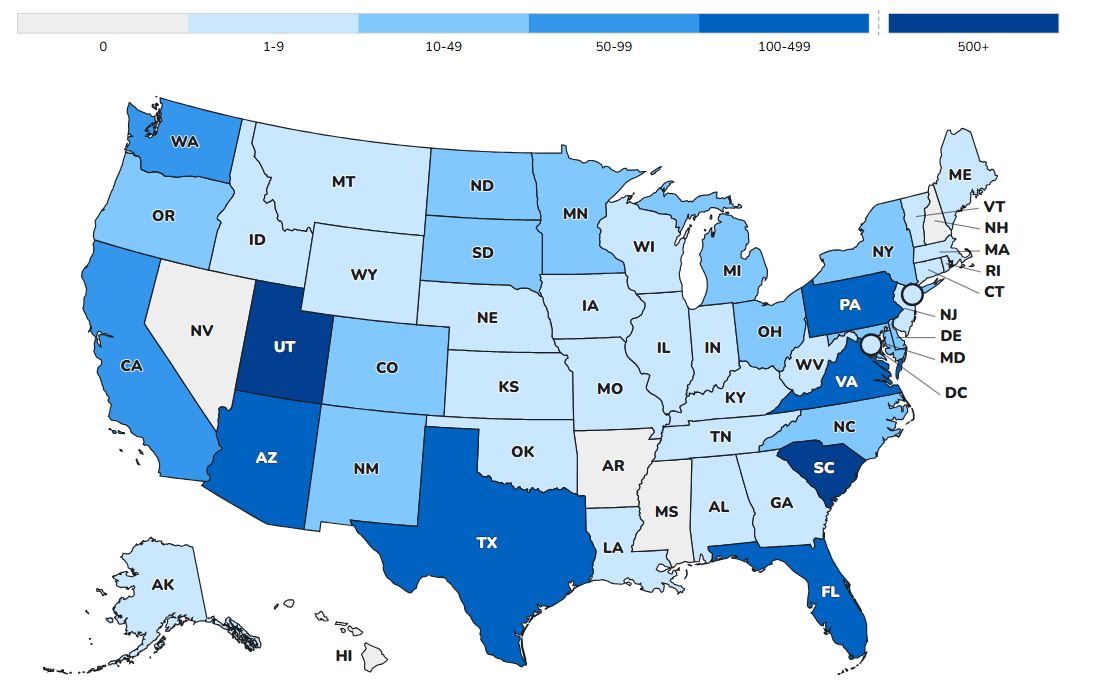
But uptake is uneven. For example, the country’s largest active measles outbreak is in Lancaster County, Pennsylvania, where more than a dozen schools have MMR rates below 70%. In these buildings, a single exposure can set off a cascade of hospitalizations, mandatory quarantines, children missing school, and parents missing work.
“All we need is one case to start something,” said Nagel.
Schools are higher-risk settings
Schools are higher-risk settings for measles, said Zach Moore, MD, MPH, North Carolina’s state epidemiologist and president-elect of the Council of State and Territorial Epidemiologists.
Kids tend to have more physical contact with each other than adults do, and classrooms are confined spaces. Also, particles of the measles virus can remain in the air up to two hours after an infected person leaves an area, so as students move from room to room throughout the day, they can become infected, even if everyone in their own class is healthy.

Credit: Daderot / Wikipedia
It seems that unvaccinated kids are especially at risk if they attend a school with a lower percentage of MMR coverage, said Moore, citing unpublished research North Carolina did in collaboration with South Carolina and the US Centers for Disease Control and Prevention. He anticipates the study will be released later this year.
Generally, people fully vaccinated with the MMR vaccine are a dead end for transmission. But so-called breakthrough cases can occur; 3% of the 2,566 measles cases reported in the United States so far this year were among fully immunized patients. In the rare instance of a breakthrough, it’s more likely to happen in an environment where multiple people are infected
“The intensity of exposure matters,” said Moore, who added that a lot of fully vaccinated kids who get measles catch the virus from someone they live with.
However, the MMR shot prevents severe illness and long-term complications, and vaccinated people are less likely to spread the virus to others.
Outbreaks becoming more frequent, intense
There have always been clusters of unvaccinated kids and adults. But experts interviewed for this story said that, before the COVID-19 pandemic, these pockets tended to be fewer and smaller.
As recently as a decade ago, MMR rates were high enough that parents who chose not to vaccinate their kids could feel somewhat confident measles wouldn’t enter their entire community. In the rare event of an outbreak, public health workers could intervene to prevent the virus from spreading to additional people.
Now that vaccine skepticism has become more prevalent, gaps in MMR coverage have grown. That’s increased the frequency and severity of measles outbreaks, including school-based outbreaks, said Margot Savoy, MD, MPH, the chief medical officer of the American Academy of Family Physicians.

Credit: beichh4046 / iStock
In Utah, for example, a high school wrestling tournament in February led to measles spreading throughout the state. With 526 cases and counting, Utah ranks second to South Carolina in total infections for 2026, a record-breaking year for the disease. The number of cases reported across the United States hit a 35-year high in July, with year-to-date infections surpassing those reported for all of 2025.
“I’m getting nervous because it’s not getting better,” said Savoy.
School nurses on alert
School nurses have been preparing for the possibility of measles outbreaks coming to their districts for the past few years, said Lynn Nelson, MSN, president of the National Association of School Nurses.
It’s been roughly two generations since measles posed this level of threat in the United States, so recent preparation has included ensuring nurses can appropriately refer families to medical care. People should phone ahead and not just show up at a doctor’s office, urgent care center, or emergency room so that clinicians can take precautions to protect the health of other patients.
A pernicious aspect of measles is that its first symptoms resemble other respiratory illnesses and people are infectious up to four days before the telltale rash of flat red spots appears. That puts the onus on school nurses to know which students are unvaccinated or immunocompromised, and to work with other public health officials to identify exposures in the event of an outbreak.
I’m getting nervous because it’s not getting better.
“Our kids don’t just live at school,” said Nelson. “They go home to their families and their grandparents and their pregnant moms and newborn babies.”
For this reason, the American Academy of Pediatrics recommends that its members collaborate with school nurses and advocate for adequate school nurse staffing, noting that just 65.7% of schools have full-time nurses.
Younger kids face the most risk
A small percentage of people who get the measles will die or suffer life-altering complications, including blindness, hearing loss, permanent scarring to the lungs, intellectual disabilities, and other lasting neurologic deficits. Additionally, the virus can erase pre-existing antibody cells, which leaves people vulnerable to other viruses and bacteria for years.
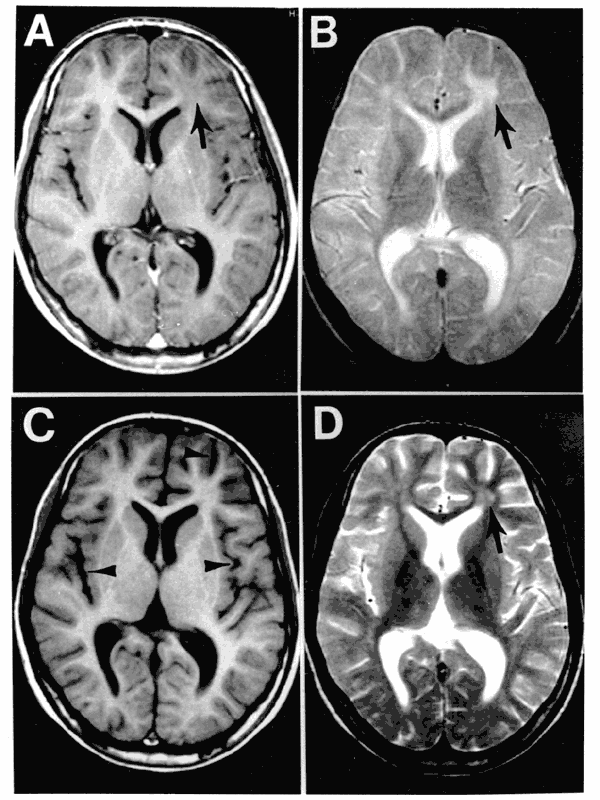
Perhaps the most insidious outcome is a condition called subacute sclerosing panencephalitis (SSPE), in which a latent measles infection mutates inside the brain, causing progressive cell death and atrophy until the area of the brainstem that controls breathing is destroyed. This rare disease shows up roughly a decade later in people who seem to have fully recovered from a measles illness, meaning it will be years before any SSPE cases stemming from recent outbreaks emerge.
Credit: Bonthius1b.gif / Wikipedia
The younger the patient, the greater the risk of SSPE, fatality, or other devastating outcomes. That is why Nagel in Denver advises parents to get their baby an early MMR shot if they travel to areas in the United States where there is an ongoing outbreak. Normally, the first MMR is given at 12 to 15 months, and up until last year, Nagel recommended an early shot only when families traveled internationally.
Experts told CIDRAP News that what’s so maddening about the spread of measles is that, if enough people were vaccinated, the disease could be eradicated. In fact, vaccination rates were so high in the late 1990s that measles was declared eliminated in the United States in 2000.
“We had already figured this one out,” said Savoy. “We were winning.”
“It’s never too late to choose different,” she added.