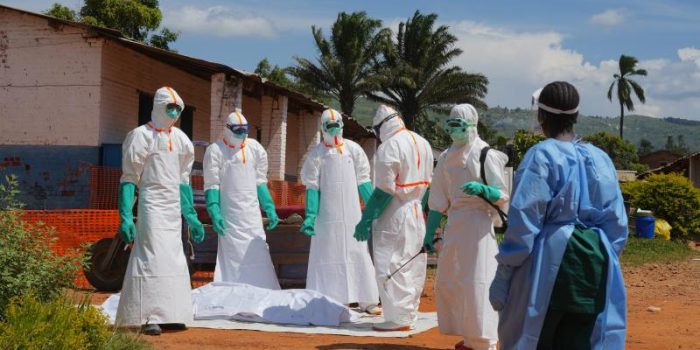
The World Health Organization (WHO) and the Africa Centres for Disease Control and Prevention (Africa CDC) today announced a joint plan to respond to the Ebola outbreak in the Democratic Republic of the Congo (DRC) and Uganda over the next 6 months.
The plan aims to raise $518 million to help African countries and partners to strengthen outbreak response measures through November 2026 and aims to complement response plans already launched by the governments of DRC and Uganda.
“The objective is straightforward: We need to stop the outbreak where it is, support countries that are responding today, and ensure that neighboring countries are ready to detect and act quickly if cases appear,” WHO Director-General Tedros Adhanom Ghebreyesus, PhD, said at a press conference.
Tedros said the only way to beat the outbreak is through partnership with the affected countries in one coordinated effort, guided by the principle of “one plan, one budget, one team.”
The Ebola outbreak, which is centered in the DRC’s Ituri province, currently stands at 381 confirmed cases and 62 confirmed deaths in the DRC, with 16 confirmed cases and one death in Uganda. The overall case-fatality rate is 15.9%, but there are still more than 250 suspected deaths, said Africa CDC Director-General Jean Kaseya, MD, MPH.
Eight patients (six in the DRC and two in Uganda) have recovered from infections caused by the Bundibugyo strain of Ebola, which has no licensed treatments or vaccines.
The outbreak was declared on May 15, but officials believe it started much earlier.
The objective is straightforward: We need to stop the outbreak where it is, support countries that are responding today, and ensure that neighboring countries are ready to detect and act quickly if cases appear.
Kaseya noted that the number of confirmed Ebola cases is significantly higher than previous Ebola outbreaks through 21 days, including the 2014-2016 West Africa outbreak, which has been the largest to date. It’s the fourth-largest outbreak overall and the largest cause by the Bundibugyo virus.
“This a very serious outbreak, and we need to stop it now, where it is,” Kaseya said.
The WHO said implementation of preparedness and response activities is under way across affected and at-risk countries.
CDC modeling study highlights potential size of outbreak
At another press conference held today, officials with the US CDC discussed a new paper published by the agency that illustrates how big the outbreak could get.
The paper, published today in Morbidity and Mortality and Weekly Report (MMWR), presents a series of modeling estimates based on what is known about the outbreak. Under a scenario in which only 20% of infected people were successfully detected and isolated within two days of infection, the outbreak could exceed 20,000 cases and 4,000 deaths by mid-August. The 2014-2016 West Africa outbreak had more than 28,000 cases and 11,000 deaths.
The study projects that the outbreak could be smaller under scenarios in which 70% to 95% of infected people are detected and isolated within two days. But Pillai said that, from what’s known on the ground, those percentages are likely on the lower end.
“The outbreak currently under way is serious because of the scale of transmission, because of the conditions in the affected regions, including active conflict, and significant challenges to healthcare access,” said Satish Pillai, MD, MPH, incident manager for the CDC’s Ebola response, adding that the situation deserves “serious, sustained attention.”
Pillai said the purpose of the modeling is to determine where resources and attention are needed and “keep the worst-case scenarios from becoming a reality.”
In another study published today in MMWR, the CDC said the risk posed by the outbreak to the US population remains low over the next three months, with a minimal risk of cases being introduced into the country. Pillai said the risk of secondary transmission is also low even if a case were to be introduced, “given the strength of our public health system and clinical infection control measures.”
“For Americans going about their daily lives, including those with travel plans that do not involve the affected countries, there’s no recommended change in behavior at this time,” he said.
A third MMWR paper describes what is currently known about the outbreak and summarizes actions taken by the CDC and the US government.