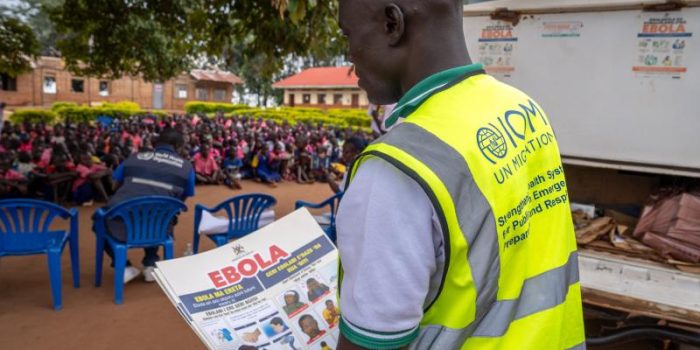
The World Health Organization (WHO) and Africa Centres for Disease Control and Prevention (Africa CDC) yesterday called for an “urgent scale-up” of the Ebola response in the Democratic Republic of Congo (DRC) as the outbreak continues to grow.
The call comes on the heels of a visit to DRC and Uganda earlier this week by WHO Director-General Tedros Adhanom Ghebreyesus, PhD, and Africa CDC Director-General Jean Kaseya, MD, who met with national and provisional authorities and response coordinators in the two countries. Stops on the trip included Ituri province, the epicenter of the outbreak.
While Uganda’s outbreak has been declared over after 20 cases and two deaths, there are now 4,053 confirmed Ebola cases in the DRC and 1,850 deaths. It’s already the second deadliest Ebola outbreak in history and is showing no signs of slowing down, with an average of 75 new cases each day.
Infections outside of case contacts a ‘major concern’
“In some areas of eastern DRC, the Ebola outbreak is outpacing our response, making it imperative that we rapidly scale up every aspect of our efforts to contain it,” Tedros said in a WHO press release.
The WHO and Africa CDC say cases need to be identified earlier, daily contact follow-up needs to be at least 95%, and testing, referral, isolation, and treatment services need to be brought closer to affected communities.
Touching on a theme that he’s highlighted in recent weeks, Kaseya said community leaders in the affected areas need to be more involved in the response, which has been hindered by community mistrust.
“Containing and ultimately stopping this outbreak will come from communities,” Kaseya said. “When people have information they trust, can report symptoms early, and seek care without fear, we can break every chain of transmission.”
In some areas of eastern DRC, the Ebola outbreak is outpacing our response, making it imperative that we rapidly scale up every aspect of our efforts to contain it.
In a press briefing yesterday, Kaseya noted that the number of confirmed cases in the outbreak is more than eight times the number in the 2014-2016 West Africa outbreak at the same time-point (11 weeks), and deaths are six times higher. The outbreak has expanded from nine health zones in the DRC at its onset to 51. More than 70% of new cases and 67% of deaths are coming from the community rather than the list of case contacts.
“This is a major concern,” Kaseya told reporters.
Kaseya said Africa CDC and the WHO need to conduct studies to determine whether the rare Bundibugyo virus, which is the cause of the outbreak, has mutated.
“The level of severity of this outbreak is unprecedented,” he said. “We’ll start some studies to understand if there was a mutation.”
WHO recommends Ervebo for evaluation
In other news, the WHO said today that the Ervebo vaccine, which targets Zaire Ebolavirus and has been used in previous outbreaks, should be prioritized for inclusion in a phase 3 randomized clinical trial assessing vaccines for the current outbreak.
There are no licensed vaccines or treatments for the Bundibugyo virus (BDBV), which is one of six species that cause Ebola. Two Bundibugyo-specific vaccine candidates—Moderna’s mRNA-149 and Oxford Vaccine Group’s ChAdOx1 BDBV vaccine—have launched phase 1 trials in recent weeks. A recent study in the New England Journal of Medicine found that Ervebo might offer some cross-protection against Bundibugyo virus.
At the start of the outbreak, the WHO’s Technical Advisory Group on Candidate Vaccine Prioritization said Ervebo should not be used “outside carefully designed research settings.” But after reviewing the latest data on Ervebo on July 31, members agreed that, while a specific Bundibugyo vaccine is the preferred option, there were no safety concerns about the vaccine “if used in the context of a BDBV outbreak in which contacts of cases are vaccinated.”