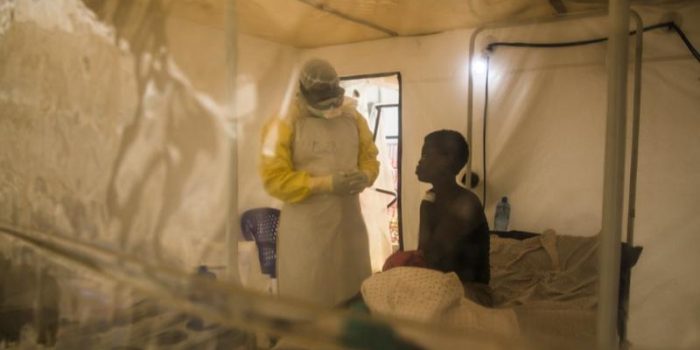
To add to an already difficult public health crisis, some healthcare workers in the Democratic Republic of the Congo (DRC) have gone on strike, saying they are fighting an Ebola virus in an outbreak with inadequate equipment and low wages, the Associated Press (AP) reports. While no official strike has been declared, workers are leaving their jobs at clinics and treatment centers amidst the growing outbreak.
As of today, BNO News notes 1,729 Ebola cases and 582 deaths in the DRC and Uganda, where the Bundibugyo strain of the virus is spreading in an already chaotic region.
Workers in Ituri province, the epicenter of the outbreak, told the AP they have not been paid wages and bonuses since the outbreak was declared on May 15. In addition to healthcare workers, safety and security teams who help identify Ebola in the community are also striking.
Government officials in Ituri said the missing payments are because of the broader implications of the outbreak. “The fact that Bunia airport is closed is hampering the very implementation of the response, particularly certain aspects of the flow of funds. This is one of the reasons that may account for the delay in payment,” Akilimali Pierre, the incident manager at Congo’s National Institute of Public Health, told the AP.
The strike is causing residents of Ituri province to worry that worker absences will only continue to foment case transmission.
Bhattacharya addresses Ebola response, CDC staffing
Yesterday in an email sent to US Centers for Disease Control and Prevention (CDC) employees, acting CDC Director Jay Bhattacharya, MD, PhD, said the outbreak, which is already the third-largest in history, requires a renewed call for frontline responders. Bhattacharya said the CDC’s involvement will last for several months and require more personnel.
“The coming months will require us to make hard decisions about how to prioritize work, especially programmatic activities in [CDC centers, institutes, and offices, or CIOs],” he wrote in an email obtained by the Federal News Network. “We understand the challenges related to balancing program priorities and support for emergency responses, and we appreciate your leadership and flexibility in planning for how your CIO can support response needs.”
The coming months will require us to make hard decisions about how to prioritize work.
Currently the Ebola outbreak is designated as a level 1 response for the CDC, which requires the “largest number of staff possible to work 24/7 on the response,” the email said. The last time the CDC had a level 1 activation was during the COVID-19 pandemic in 2020, when the agency had more than 3,000 more staff working with state and federal offices on response.
Bhattacharya is encouraging staff to enroll in the CDC Ready Responder program, which helps train for emergency response.But staff said the agency must grow by hiring more scientists to meet the needs of the Ebola outbreak, as well as domestic measles outbreaks, foodborne illnesses, and New World screwworm in animals.
This fiscal year, the CDC has made only 38 new hires.