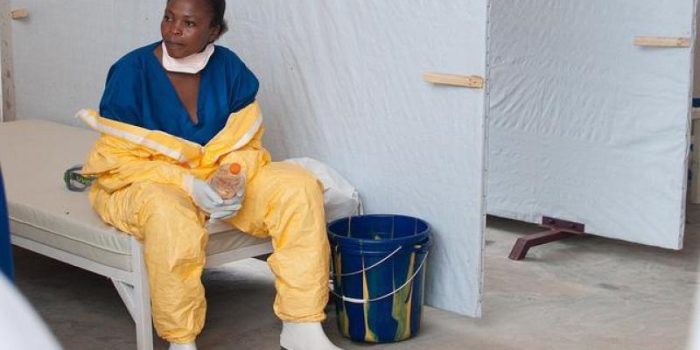
There are now 600 suspected cases and more than 160 deaths in a growing Ebola outbreak in the Democratic Republic of the Congo (DRC) and Uganda, the World Health Organization (WHO) said today, with numbers expected to rise.
“Our absolute priority now is to identify all the existing chains of transmission,” Chikwe Ihekweazu, MBBS, MPH, WHO emergencies chief, said today at a press conference.
So far, 51 cases have been confirmed in the DRC provinces of Ituri and North Kivu, where a major Ebola outbreak took place in 2018-19. Uganda has also confirmed two cases in the capital, Kampala.
The WHO today said the first suspected case may date back to April 20 but that the previously reported May 5 funeral of a patient, which involved changing coffins and an open casket, was likely a superspreader event. No vaccines or therapeutics are available for the Bundibugyo strain of Ebola, which is causing this outbreak. The WHO estimates the case-fatality rate of Bundibugyo at around 40%.
Decision to send American doctor to Germany questioned
Yesterday and today, the US Centers for Disease Control and Prevention (CDC) confirmed during media calls that the overall risk to Americans is low and that seven Americans exposed to the virus in the DRC and Uganda have been evacuated by the State Department to Germany. One of the seven, an American doctor in Uganda, has been taken to the Czech Republic for observation.
Only one American, Peter Stafford, MD, is confirmed to have the virus. He is being treated at Charite University Hospital in Berlin, and the CDC said he in stable condition. His wife and children have also been evacuated to Germany and are being monitored.
During the media call, Satish Pillai, MD, MPH, incident manager for the US CDC’s Ebola response, said the choice to move Stafford to Charite instead of an American hospital was,“…based on the conditions on the ground, the need to rapidly mobilize, as you know, that this was a very rapid set of circumstances that unfolded over the weekend.”
Anonymous sources told the Washington Post today that the decision was made by the White House and President Donald Trump, who did not want the optics of bringing an Ebola-infected person onto US soil. A spokesperson for the White House denied that claim.
The United States has an ironclad commitment to ensuring this response is fully resourced.
Yesterday, Secretary of State Marco Rubio said the United States would fund up to 50 Ebola treatment units in the outbreak area. “The United States has an ironclad commitment to ensuring this response is fully resourced, rapid, and cooperative between key global health and humanitarian partners,” read a statementfrom the State Department.