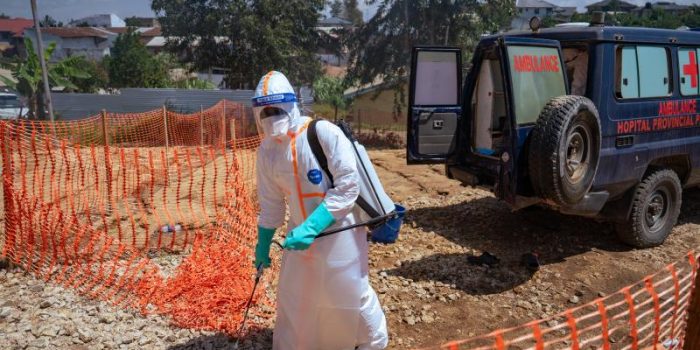
As Ebola cases and deaths in the Democratic Republic of the Congo (DRC) continue to climb, a senior World Health Organization (WHO) official is warning that the outbreak could be much larger than case counts indicate.
Chikwe Ihekweazu, MBBS, MPH, executive director of the WHO Health Emergencies Programme,told Reuters that 80% of new Ebola patients in Ituri province—the epicenter of the outbreak—are not on contact lists of existing patients. That suggests the outbreak, which is caused by the Bundibugyo virus, is largely spreading undetected.
Ihekweazu said estimates based on modeling and test-positivity rates indicate the number of cases could be two to four times higher than confirmed cases.
According to the daily Ebola update from BNO News, DRC has 1,792 confirmed Ebola cases and 625 deaths. The case-fatality rate is 34%. Neighboring Uganda has 20 confirmed cases and two deaths.
“We continue facing the fastest-growing Ebola outbreak ever on the continent,” Wessam Mankoula, MBBS, MPH, an epidemiologist with the Africa Centers for Disease Control and Prevention (Africa CDC), said yesterday in a press briefing.
We continue facing the fastest-growing Ebola outbreak ever on the continent.
The outbreak is already the third-largest on record and could surpass the 2014-2016 West Africa outbreak and the 2018 North Kivu, DRC, outbreak at its current rate. Mankoula highlighted a chart showing that 1,596 cases were reported in the DRC in the first six weeks after the outbreak was declared in mid-May, compared with 994 in the first six weeks of the West Africa outbreak and 378 in the North Kivu outbreak.
“Unfortunately, the virus is still ahead of our response,” Mankoula said. “It’s moving faster than we can deploy the resources to control the situation.”
32 DRC healthcare workers dead from Ebola
DRC is no stranger to Ebola, having experienced 16 outbreaks prior to the current one. But the challenges facing the response are numerous and include an ongoing conflict between the Congolese military and rebel groups, insufficient contact tracing, and community mistrust. On top of that, Ebola responders in the country’s hardest-hit province went on strike this week over unpaid benefits and poor working conditions.
Mankoula noted that 112 healthcare workers in DRC have gotten infected, and 32 have died. “We’re still losing our healthcare workers in DRC,” he said.
There are no licensed treatments or vaccines for Bundibugyo. A clinical trial for two antiviral treatment candidates—the monoclonal antibody MBP134 and the antiviral remdesivir—began enrolling patients last week in the DRC, but it could take several months before trial investigators know if either of those treatments is effective.
The trial is currently being conducted at one site in the DRC, but Africa CDC officials said the plan is to eventually scale it to 10 sites.