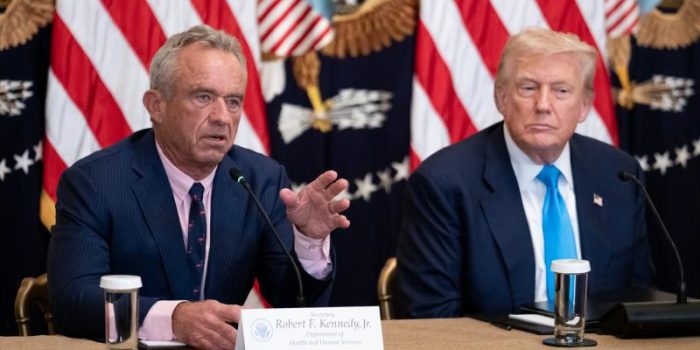
There were fireworks during Health and Human Services (HHS) Secretary Robert F. Kennedy Jr.’s testimony today before the House Education and Workforce Committee, as Kennedy faced a second day of criticism from Democrats.
Kennedy’s appearance was ostensibly to discuss next year’s HHS budget. But, as was the case during yesterday’s hearing before the House Ways and Means Committee, he was grilled on the ongoing spread of measles: Last year, the Centers for Disease Control and Prevention, which is an HHS agency, reported 2,288 cases of measles in the United States, the most infections since 1991.
Children are dying of diseases that we thought we had eradicated.
Democratic Rep. Haley Stevens of Michigan, who introduced articles of impeachment against Kennedy in December 2025, said Americans are less safe under his watch.
“Children are dying of diseases that we thought we had eradicated,” she said.
Measles was declared eliminated in the United States in 2000 because of widespread vaccination, which is 97% effective after two doses. But growing pockets of the country are now below the 95% threshold needed to maintain herd immunity.
The declining vaccination rates coincide with growing skepticism about vaccine safety and efficacy.
Kennedy, a scion of America’s most storied political dynasty, was a prominent anti-vaccine activist before joining the Trump administration. For at least two decades, he has publicly questioned the safety of various immunizations.
Rep. Suzanne Bonamici (D-OR) pointed to Kennedy’s record, telling the secretary that he should resign from HHS.
“Let someone with real qualifications run this agency,” she said.
Kennedy says measles rise predates his HHS leadership
Republicans were solicitous of Kennedy throughout the hearing, and Rep. Bob Onder (R-MO) implied that Stevens’ impassioned criticism of Kennedy was motivated by a desire to go viral on social media.
For his part, Kennedy seemed unfazed by verbal attacks from Democrats as he defended his record, noting that measles cases were on the rise in the United States before he took over as head of HHS.
Kennedy’s two decades of vaccine skepticism, including as chair of Children’s Health Defense, is part of that picture regardless of his swearing-in date.
That framing is misleading, said Jake Scott, MD, an infectious disease physician at the Stanford University School of Medicine.
The recent large measles outbreaks are occurring because of years of falling vaccine coverage, said Scott. “Kennedy’s two decades of vaccine skepticism, including as chair of Children’s Health Defense, is part of that picture regardless of his swearing-in date,” he said.
It’s striking how many fewer parents are vaccinating their kids since Kennedy took office, said David Hill, MD, a spokesperson with the American Academy of Pediatrics.
While correlation doesn’t prove causation, Hill said, it would be interesting to replace Kennedy with someone who has “a more scientific understanding of public health and see if the trend reverses.”
Kennedy said, “I have never been anti-vaccine,” but also said that vaccines are not adequately tested for safety. He’s made numerous similar previous statements questioning the value of vaccination and has also said that the measles vaccine causes deaths “every year.”
There have been no deaths shown to be related to the measles, mumps, and rubella (MMR) vaccine in healthy people, according to the Infectious Diseases Society of America.
“There have been rare cases of deaths from vaccine side effects among children who are immune compromised, which is why it is recommended that they don’t get the vaccine,” the society states.
Measles deaths in Texas were preventable
The medical system needs to be more understanding of people who don’t want to vaccinate, some of whom forgo treatment for religious reasons, argued Kennedy.
He said that HHS doesn’t advise doctors on how to treat people who are “actually sick” because it has been “so focused on a single intervention,” meaning vaccination.
Kennedy added that the two unvaccinated girls in Texas who died from measles last year could have been saved, “if the hospital gave them proper treatment.”
Measles is a horrible disease, and complications can be fatal—even with the best medical care in the world. That’s why prevention is so important!
Kennedy did not explain what qualifies as proper treatment. Unless the medical records are released and reviewed by trained medical professionals, it’s inappropriate to rely on conjecture or imply that different treatment could have changed the outcome, said Ari Brown, MD, a board-certified pediatrician based in Texas.
“Measles is a horrible disease, and complications can be fatal—even with the best medical care in the world. That’s why prevention is so important!” she said.
The only treatment of measles is supportive care: oxygen, fluids, management of secondary bacterial infections—such as pneumonia—and, under physician supervision, vitamin A, said Scott, who added that the girls who died had been healthy children prior to getting measles.