A Public Health Alerts report today details successful administration of intramuscular immunoglobulin (IMIG) as post-exposure prophylaxis (PEP, for prevention) to 11 babies exposed to measles in Utah last year.
IMIG is an option for preventing measles in infants after exposure to a person with the disease, wrote the authors, from the Utah Department of Health and Human Services (DHHS) and elsewhere in Utah. Typical dose is 0.5 milliliters (mL) per kilogram (kg), but no clear PEP guidelines exist.
“Utah DHHS worked with the local health department and health care facility to develop a plan for administration that has been used in subsequent exposure events in Utah,” the authors noted.
Public Health Alerts, a collaboration between NEJM Evidence and CIDRAP, fills a gap in reliable data, offering expert-reviewed reports that translate frontline observations into actionable public health evidence. An NEJM Evidence editorial explains the initiative further.
Utah is a hot spot for measles cases this year, confirming 466 in 2026 as of yesterday. The state had 197 cases for all of 2025.
All parents accepted IMIG
Utah DHHS was notified on September 19, 2025, of a measles exposure at a large pediatric clinic that had occurred about 84 hours (three and half days) earlier. Because of the time that had elapsed, IMIG and not vaccination was considered the only option to prevent additional cases.
The initial list of PEP-eligible people included nine infants, but parents identified two more who had been in the waiting room during the exposure window. The median weight of the 11 babies was 6.7 kg (14.8 pounds).
“To administer the appropriate dose to infants, public health staff worked with health care partners to determine a strategy,” the authors wrote.
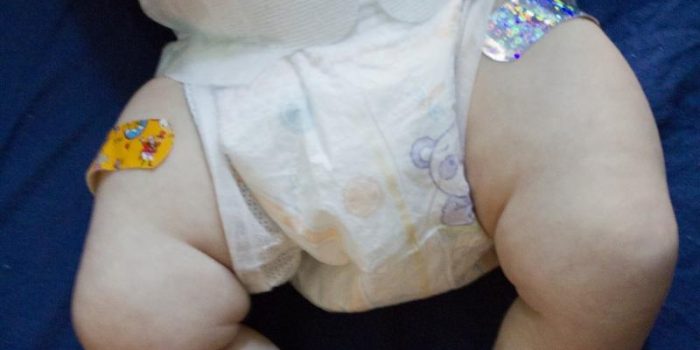
Healthcare providers administered up to 1.5 mL in each vastus lateralis (outer thigh) to accommodate total doses of up to 3 mL. Administration was more challenging for infants who weighed less than 6.0 kg (13.2 pounds). Providers gave three infants a third injection of up to 1.5 mL in an alternate vastus lateralis site separated by an inch or more from the first injection. In four infants, the provider opted to administer a lower dose (76% to 96% of the total weight-based dosage) to prevent an additional injection.
No parents declined IMIG for their infants, and no adverse events were recorded. None of the infants who received PEP contracted measles within the 21-day monitoring period.
The authors noted, “In the period following the initial event, local health departments and health care systems have reported that at least 60 additional infants have received IMIG as measles PEP in Utah.
“Some providers have administered injection volumes as large as 2.1 ml in a vastus lateralis muscle, although the majority of providers chose to divide total doses exceeding 3 ml into three or four injections of 1.5 ml or less. Third and fourth injections have been given as additional vastus lateralis injections or ventrogluteal injections.
“We have not received any reports of serious adverse reactions in any infants who received IMIG as measles PEP.”