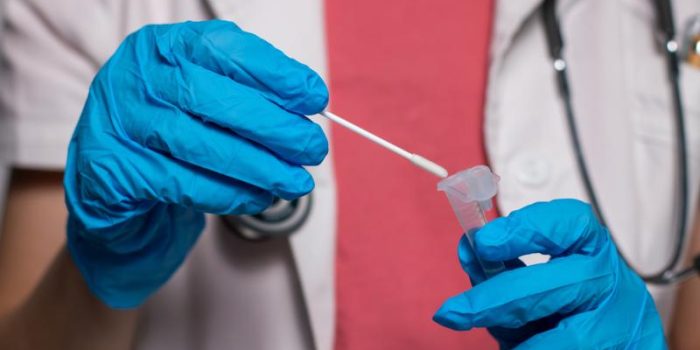
Rapid diagnostic tests that can help distinguish whether a patient has a viral or bacterial infection have long been viewed as a critical tool for reducing unnecessary outpatient antibiotic prescribing.
But the results of a randomized clinical trial conducted in England indicate that rapid tests don’t address all the issues at play when a clinician prescribes an antibiotic.
The study, published this week in JAMA Internal Medicine, found that use of a rapid multiplex microbiological point-of-care test (RM-POCT) in adults and children with symptoms of a respiratory tract infection did not reduce same-day antibiotic prescribing compared with a control group that received usual care.
The investigators say the results suggest that rapid point-of-care tests aren’t an “antimicrobial stewardship silver bullet.”
“Getting antibiotic prescribing right is a multifaceted, complex problem that requires multifaceted, complex responses,” lead study author Alastair Hay, MD, a professor of primary care at Bristol Medical School, told CIDRAP News.
Absence of a virus may have encouraged prescribing
The randomized trial was conducted at 16 general practices in southwest England from December 2022 to April 2024. Participants included patients aged 1 year and older who presented with respiratory tract infection symptoms.
In England and many other high-income countries, respiratory infections are a primary driver of antibiotic prescribing. Roughly half of patients who show up with respiratory symptoms in outpatient care settings, like physicians’ offices and urgent care centers, receive an antibiotic. Yet previous research has shown that as many as half of those prescriptions are unnecessary.
Half of the 522 enrolled patients enrolled in the new study were tested with an RM-POCT that indicates the presence or absence of 19 viruses and four atypical bacterial species in 45 minutes (the intervention group). The control group received usual care. The primary outcome was same-day antibiotic prescribing. The secondary outcome was patient-reported symptom severity on days two to four.
Overall, same-day antibiotics were prescribed to 124 participants (45%) in each group (odds ratio [OR], 1.00). Use of the RM-POCT did, however, significantly reduce antibiotic prescribing in the patients who tested positive for a virus; only 22% of patients in the intervention group received antibiotics when a virus was detected, compared with 46% in the control group (OR, 0.35). But that was offset by an increase in prescribing when no virus or atypical bacteria were detected (OR, 1.89).
Getting antibiotic prescribing right is a multifaceted, complex problem that requires multifaceted, complex responses.
There was no difference in symptom severity on days two to four between the two groups.
“Our results suggest an RM-POCT that only tests for viruses and atypical bacteria is unlikely to be clinically effective, let alone cost-effective, in primary care,” the study authors wrote.
Jonathan Ryder, MD, a clinician and associate medical director of the antimicrobial stewardship program at the University of Nebraska Medical Center, said the findings are consistent with previous trials of rapid molecular respiratory point-of-care tests “that have in aggregate failed to demonstrate a decrease in antibiotic use.” But he was surprised by the increase in prescribing when no virus was detected.
“Thus, the test did affect clinician behavior in some anticipated respects but had unintended effects as well,” said Ryder, who wasn’t involved in the study.
Hay said he and his colleagues were initially surprised by the findings, “but once we dug into the results, they seem to make sense.”
“When a virus was present, antibiotic prescribing fell,” he said. “But where it was absent, prescribing increased—presumably because prescribers felt that the absence of a virus meant they had to cover the possibility the infection was bacterial.”
The authors note that because the test used in the trial detected only atypical bacteria, clinicians may have interpreted a negative result as indicating the possible presence of bacteria that typically cause respiratory infections, like Streptococcus pneumoniae. That concern may have led them to prescribe an antibiotic.
But Hay noted that even if you had a test that could detect typical bacteria, it wouldn’t necessarily indicate an infection that required antibiotics, because the nose and throat—and other sites where bacterial infections occur—aren’t sterile.
“Detecting the microbe is present is not enough—we then have to distinguish if that microbe is commensally carried [not causing disease] or the pathogen causing the symptoms,” he said.
Patients may expect antibiotics, even when they’re not needed
In an editorial that accompanies the study, experts from Northwestern University Feinberg School of Medicine and the University of Utah’s Spencer Fox Eccles School of Medicine say the findings highlight why “we are unlikely to test our way out of inappropriate antibiotic prescribing,” even if the tests become more precise.
“Precision microbiology will not address the complex social, emotional, and organizational factors that are associated with care seeking and most inappropriate antibiotic prescribing,” Jeffrey Linder, MD, MPH, and Julia Szymczak, PhD, wrote.
Among those factors are the common belief among patients that antibiotics might help but cannot hurt, and that antibiotics have helped with respiratory infections in the past. Linder and Szymczak also note that care-seeking is an indication that the patient has determined their symptoms warrant medical attention. “Patients may expect (and clinicians may think patients expect) a tangible intervention in exchange for the time and money spent on consultation,” they wrote.
Precision microbiology will not address the complex social, emotional, and organizational factors that are associated with care seeking and most inappropriate antibiotic prescribing.
Ryder concurs that rapid tests alone won’t solve the problem.
“In isolation, rapid, molecular, point-of-care tests do not seem to decrease unnecessary antibiotic use for respiratory infections,” he said. “For these to be best utilized, there likely needs to be multimodal antimicrobial and diagnostic stewardship interventions focused on behavioral science, education/guidance, and clinician feedback.”
Linder and Szymczak say more research is needed to identify strategies to help patients manage symptoms of self-limiting conditions without starting a process that can result in expensive diagnostic testing and unnecessary antibiotic prescriptions.