 20 Years of HPV Vaccine Success
This is part 1 in a three-part series marking the 20th anniversary of the approval of the HPV vaccine. Parts 2 and 3 will publish tomorrow and June 10. All will be available here.
Erica Frazier Stum walked down the aisle in a sleeveless white wedding gown covered in lace and tiny beads. She wore a double-stranded pearl necklace, dangling pearl earrings, and teal and purple shoes.
And she was completely bald.
Stum, who shaved her head before beginning chemotherapy for relapsed cervical cancer, refused to allow the disease to delay her wedding, said her younger sister, Hallie Martin.
Even as her cancer spread, Stum was determined make the most of her time with her family, including her son.
“I may not be getting rid of my cancer,” Stum said during a speech for a cervical advocacy group called Cervivor, “but I’m absolutely defeating cancer by the way I live my life.”
‘She just knew’
Stum was passionate about making life better for people with cervical cancer. She gave speeches and talked to lawmakers to spread the word that cervical cancer can be prevented through screenings and vaccination.

Stum’s sister was part of the first generation of girls protected by vaccines against the human papillomavirus (HPV), which causes six types of cancer, including nearly all cervical cancer. Martin was vaccinated at 17 in 2006, the first year that the vaccine became available.
Stum was not as lucky.
At 21, Stum had already tested positive for HPV at one of her annual exams. Although the shots were licensed for girls and women ages 9 to 26, Stum assumed the vaccine wouldn’t help her.
Almost everyone is infected with the virus, which spreads through intimate contact, often within a year of becoming sexually active. When Stum tested positive for the virus, she had had only one sexual partner, Martin said.
“It’s called the human papillomavirus because if you are a human, you are probably going to be exposed to it,” said Rebecca Perkins, MD, obstetrician and gynecologist and investigator at the Woman, Mother and Baby Research Institute at Tufts Medical Center.
In most cases, the immune system tackles HPV and keeps it in check. In about one in 10 people, however, the body has trouble defeating HPV, and people develop chronic infections.
The first clear symptom of disease appeared in 2012, when Stum was 27 and began bleeding after intercourse with her future husband. Stum quickly scheduled a visit with a gynecologist. Martin accompanied her.
“It really does not look good,” Martin recalls the doctor saying.
The doctor suggested taking a biopsy—which involves cutting out a small piece of the cervix for testing—the same day. Martin stayed with her sister throughout the procedure.
“It was a lot of pain for her, and she just knew,” said Martin, now 36. “We left the appointment and called my mom and told her that she had cervical cancer.”
Too few take advantage of vaccination, screening
Thanks to early detection and treatment, mortality from cervical cancer, once one of the leading cancer killers in US women, has fallen by more than half since the mid-1970s.
Screening with Pap tests and, more recently, HPV tests, allows doctors to find and treat cervical cancers early, as well as treat precancerous growths before they turn malignant.
I just try to cope with it the best that I can. I do that by making memories with my family and my friends.
The availability of vaccines is gradually erasing cervical cancer from the youngest generation of US women.
Studies show that HPV vaccines reduce the risk of cervical cancer by 80% in women vaccinated by age 16 years and 66% in those vaccinated after 16. Protection appears to last decades. In Australia, where HPV vaccination and screening rates are high, health officials predict the country will eliminate cervical cancer by 2035.
But the vaccine’s benefits aren’t reaching everyone.
In 2024, only 63% of US teens age 13 to 17had received all recommended doses, according to a report from the Centers for Disease Control and Prevention.
And only 76% of women age 21 to 65 are up to date on cervical cancer screening. Women are most at risk in rural areas. Cervical cancer diagnosis and death rates are higher in rural communities, where screening and HPV vaccination rates are low, studies show.
“Every case of cervical cancer is a failure of our health system,” Perkins said.
Unwilling to put her life on hold
Stum worked as a special education teacher and had a 2-year-old son from her first marriage when she was diagnosed as having cancer. Because she wanted more children, Stum opted to treat her cancer with a limited surgery that allowed her to keep her uterus, according to a first-person account she posted on the Cervivor website.
But Stum didn’t have the chance to have additional children. “The cancer came back too quickly,” Martin said.
Cancer returned less than two years after Stum’s initial diagnosis. By that point, the disease was too advanced to be removed with surgery alone. Doctors found cancer in Stum’s lymph nodes and in multiple tumors outside the cervix.
When tests showed that a tumor was blocking Stum’s right kidney, preventing urine from reaching her bladder, her medical team recommended using a catheter to collect urine in a plastic bag. Stum used the bag on the day she remarried, Martin said.
Although Stum removed the bag while saying her vows, she reclipped it to the back of her dress for the rest of the wedding, Martin said.
Stum restarted chemo two days after the wedding. She followed up that treatment with radiation and then more chemo. Therapy brought on menopause at age 28.
Living in hope
Treatment didn’t keep the cancer at bay for long.
Stum spent her 30th birthday having surgery to remove a cancer-filled lymph node. A scan found cancer in seven parts of her body, and her doctor told her the cancer had spread too far to cure.
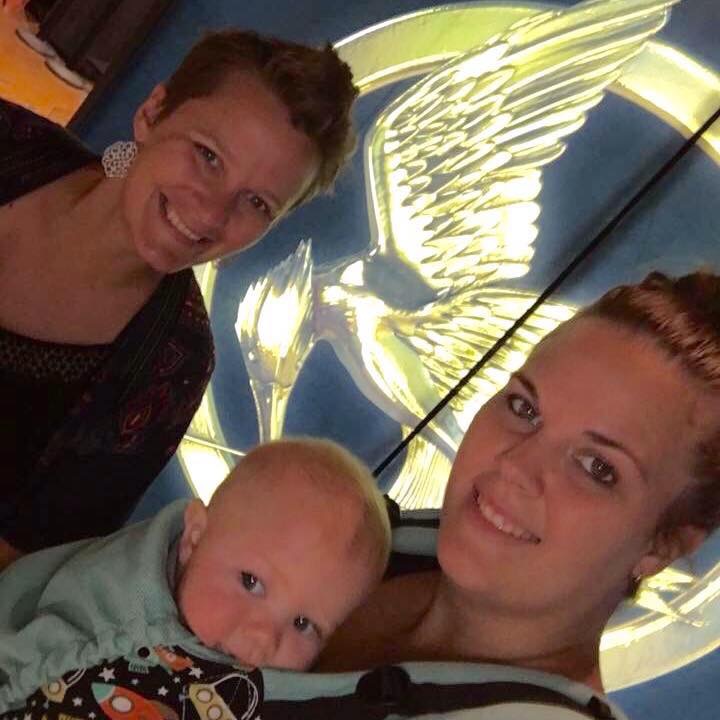
“I know that ultimately I’m going to die of this cancer,” Stum said on a Cervivor podcast. “I just try to cope with it the best that I can. I do that by making memories with my family and my friends.”
In a video on Facebook recorded when she was hospitalized, Stum said, “My biggest hope or wish is that… my son is taken care of, and that he remembers me, and remembers the fun things we got to do together.”
Stum underwent treatment with one type of medication after another. When her body was too worn down for more chemo, she looked for clinical trials. After being turned down for multiple studies, she entered a phase 1 clinical trial—the earliest and most preliminary studies of a drug—for an experimental medication.
With each new scan, she hoped for good news.
“At the age of 30, I live my life in three- to five-month chunks: the three to five months between my scans, the three to five months that I have to believe that the cancer treatment is working,” Stum said in the presentation for Cervivor.
Stum tried to help her son process his grief by writing a children’s book with him, called Living Life with Mommy’s Cancer.Cervivor distributed copies to cancer centers and to mothers with cervical cancer.
Stum wrote what she called a “living life list” of adventures she wanted to experience. She went bungee jumping in Las Vegas, learned to surf in Hawaii, and went white-water rafting in multiple states. Stum took her son to Disney World and Legoland.
“I get upset when I think that I won’t make it to when my son graduates high school or even gets into middle school,” Stum said on the podcast. “But it’s not going to help me to walk around angry about it.”
‘Everybody has a voice’
Stum became a vocal advocate for women with cervical cancer, serving as Cervivor’s “lead ambassador,” a position focused on education and advocacy.
She worked with the Indiana chapter of the American Cancer Society Cancer Action Network, speaking in front of the state legislature in 2017, in the middle of cancer treatment, to ask lawmakers to do more to prevent cervical cancer. Lawmakers responded to advocates by passing a strategic plan to reduce the burden of cervical cancer.
I may not be getting rid of my cancer, but I’m absolutely defeating cancer by the way I live my life.
Stum encouraged other cancer survivors to tell their stories.
“Everybody’s voice makes a difference,” Stum said on the Cervivor podcast. “The louder we can be, by having more people collectively, the more of a difference we can make.”
Stum also worked with pro-vaccination groups such as the Indiana Immunization Coalition to promote the HPV vaccine. When asked on the podcast what she wanted women to know about cervical cancer, Stum said:
“I have an 8-year-old child who can tell you about his mom and why she is going to die. It is important for you to vaccinate your children, prevent cervical cancer by going through screenings, and always go to your well-woman exam.”
‘I’m holding her now’
When Stum planned her funeral, she told her sister that she wanted to be cremated.

Image courtesy of Hallie Martin.
“We were talking one day and she’s like, ‘Oh, look, you can put your ashes into a magnet,’” Martin recalled. “I was like, ‘Erica, you’re not going on my fridge.’”
Instead, Martin found an artist to enclose her sister’s ashes in blue glass balls—each about the size of a baseball—for each family member, including Stum’s son.
Stum passed away at the end of 2018, a few days after Christmas, at 33.
Martin said she treasures the blue glass with her sister’s remains. During a phone interview with CIDRAP News, Martin said, “I’m holding her now.”
‘A vaccine could have saved her life’
If HPV shots had been available a few years earlier, Martin thinks her sister would have been vaccinated.
Martin would like her four sons, ages 7 to 13, to be vaccinated against HPV, which causes nearly as many cancers in US men as in women. HPV can lead to tumors of the penis, anus, and head and neck, as well as genital warts.
“I’m pro–HPV vaccine,” Martin said.
But her sons won’t be getting vaccinated any time soon, Martin said. “My husband is not pro-vaccine.”
Although their sons received routine childhood immunizations in the past, Martin said her husband doesn’t want the boys to receive any additional vaccines, including the HPV shot.
“I can’t go behind his back,” Martin said of her husband.
Instead, Martin said, she will tell her boys about the benefits of the vaccine, and how it can prevent cancer. When they turn 18, she said, she hopes they will choose to be vaccinated.
“All I can do is tell them that Aunt Erica died of this disease,” Martin said. “And that a vaccine could have saved her life.”