
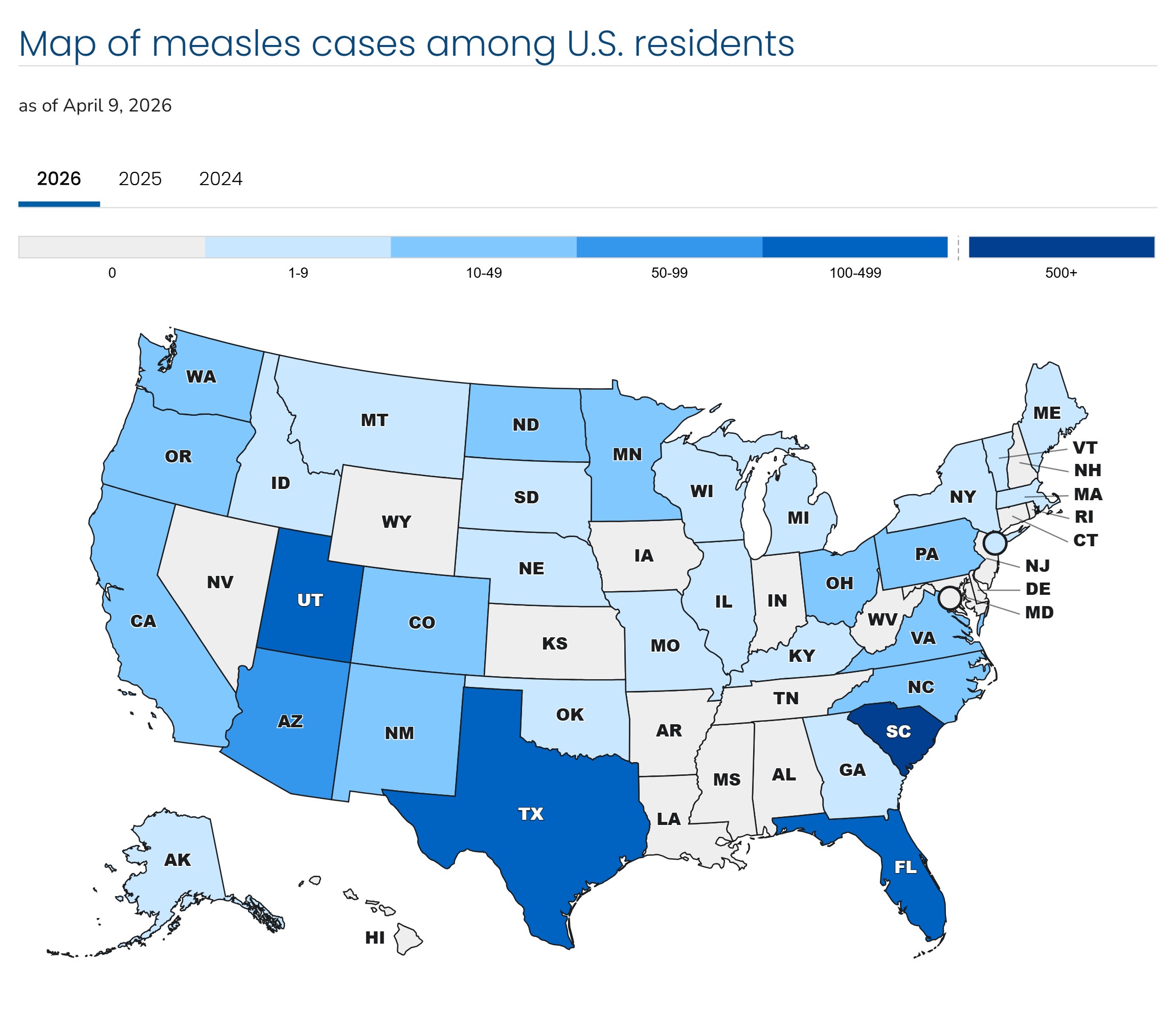
The US measles case count grew by 43 cases this past week, reaching 1,714, the Centers for Disease Control and Prevention (CDC) said today in its weekly update. The increase is much smaller than the 96-case jump last week, and more than half of the new cases are in Utah.
The CDC said all but 10 of the 2026 cases are from 32 states and New York City, with the rest travel-related. The number of affected states grew this week by one. Of all confirmed cases, 94% are associated with one of 17 outbreaks, compared with 48 outbreaks for all of last year, when the nation saw 2,286 measles cases, including three deaths.
No measles-related deaths have been confirmed yet this year, but 96 patients have been hospitalized, or 6%, compared with 11% last year. Among all patients this year, 92% are unvaccinated or have an unknown vaccine status, similar to last year.
Of the 1,714 patients, 21% are children younger than five years, and 73% are kids and young adults up to age 19.
The United States is on pace to top last year’s measles total by summer. The country will likely lose its measles elimination status—which it gained in 2000—in November, when officials assess the data.

A substantial proportion of survivors of Nipah virus infection experience long-term neurologic deficits and fatigue, according to a study published yesterday in eClinicalMedicine.
The systematic review and meta-analysis, conducted by a team of British and Chinese researchers, analyzed evidence on post-acute sequelae after Nipah virus infection from eight studies published through November 2025.
Transmitted primarily by consumption of raw date palm sap that’s been contaminated by infected fruit bats, Nipah virus’ most prominent symptoms are acute encephalitis and respiratory disease. But instances of residual neurologic symptoms have been reported by survivors ever since the first outbreak of Nipah in Malaysia and Singapore in 1998 and1999.
“Synthesising information on pathogen epidemiology is critical for epidemic preparedness, and a better definition of disease burden has been identified as a strategic goal among key research priorities for the development of Nipah virus medical countermeasures,” the study authors wrote.
Nipah strain in India, Bangladesh could have different effects
Of the eight studies included, three consisted of hospitalized Nipah encephalitis survivors, and five included survivors of Nipah virus infection more broadly. All but one focused on survivors of the Malaysia/Singapore outbreak.
Meta-analysis of five of the studies estimated the pooled prevalence of total residual neurologic effects at 45% among Nipah encephalitis survivors and 24% among survivors of Nipah virus infection. An estimated 10% of Nipah virus infection survivors experienced late-onset or relapsing neurologic symptoms after initial recovery.
The studies reported 34 different potential post-acute neurologic symptoms. In the only controlled study, total residual neurological deficits, fatigue, and excessive daytime sleepiness were significantly more prevalent in Nipah infection survivors than in household controls.
The study authors caution that the data are limited and more evidence is needed from recent Nipah virus outbreaks in India and Bangladesh, which have been caused by a different strain of the virus, to get a better sense of the prevalence of long-term neurologic symptoms among survivors.
“Estimates from this study may not be generalisable to this different clinical setting and viral strain,” they wrote.
- The Infectious Diseases Society of America (IDSA) is urging Department of Health and Human Services (HHS) Secretary Robert F. Kennedy Jr. to uphold the scientific integrity of the Centers for Disease Control and Prevention’s Advisory Committee on Immunization Practices as he reviews its charter. IDSA also warned that the revised charter will further erode US vaccine infrastructure. In related news, a federal judge has denied the Trump administration’s request to dismiss a lawsuit brought by 19 states challenging Kennedy’s HHS restructuring.
- A man returning to Italy from Senegal has been diagnosed as having H9N2 avian flu, marking the first imported infection of the virus in Europe, according to the World Health Organization (WHO) today. The National International Health Regulations (IHR) Focal Point for Italy notified the WHO of the case on March 21. The man, who also tested positive for tuberculosis, had no known exposure to poultry or anyone who had similar symptoms before illness onset. Italian authorities have implemented disease monitoring, prevention, and control measures. The WHO characterized the current risk to the general population as low but said it continues to monitor avian flu viruses around the world.
- Federal health agencies continue to investigate the source of an outbreak of Salmonella Newport infections that has now sickened 68 people in the United States, according to the Food and Drug Administration. The investigation was launched in February when cases tallied 38, but the source remains unidentified, with trace-back efforts and sample collection under way. No other information has been released.
- This week, the Global Polio Eradication Initiative (GPEI) reported five new cases of circulating vaccine-derived poliovirus type 2 (cVDPV2) in Africa. Nigeria documented three cases from Sokoto and Zamfara, with paralysis onsets in February and March, for a total of 13 so far this year. The Democratic Republic of the Congo recorded one case, from Maniema, bringing the year’s tally to three, and Somalia noted one case from Lower Juba, for a total of three cases in 2026.
State public health labs step up as CDC pauses testing for various pathogens, including rabies, mpox