A recent study has drawn attention after it detected some limited interspecies transmission of chronic wasting disease (CWD) prions in a lab. But the authors and other experts caution that the findings don’t confirm that the fatal disease is a threat to people; rather, they provide important clues to what infection might look like in humans—which is key in recognizing cases.
And for at least one CWD researcher, the failure of standard tests to detect CWD prions in infected but asymptomatic macaques has deepened concerns about relying on those tests to determine whether venison is safe to eat. Prions are misfolded infectious proteins that cause the disease in cervids such as deer and elk.
CWD is a type of transmissible spongiform encephalopathy, similar to Creutzfeldt-Jakob disease in people, and bovine spongiform encephalopathy (BSE, or “mad cow disease”) in cattle. While no people are known to have been infected with CWD, the unrelenting spread of the disease in animals across North America means increasing opportunities for the prions to adapt to different hosts.
Also, it can take a decade or longer for prions, which mainly spread through direct contact and environmental contamination, to exert their neurodegenerative effects, which in cervids can include stumbling, drooling, inability to eat and weight loss, and a lack of fear of people.
2 macaques develop signs of prion disease
The study, published in Science Advances, was 18 years in the making because of the difficulty of getting funding for this study and because study personnel were located in several countries and moved to different institutions over the study period.
“This was a big project, very complicated in the logistics, and very complicated to get it funded,” senior study author Hermann Schatzl, MD, PhD, of the University of Calgary, told CIDRAP News.
The University of Calgary–led study team orally or intracerebrally inoculated 18 female cynomolgus macaques in 2009 with different CWD prion preparations, which included tissues from elk, mule deer, and white-tailed deer in the United States and Canada. The team also inoculated three macaques with material from uninfected cervids as controls.
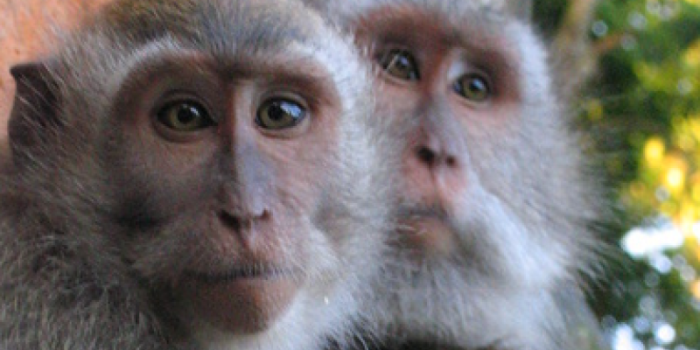
Macaques are medium-sized monkeys commonly used in research.
Huge Cyclospora outbreak spreads to 9 states