Air purifiers had a moment during the COVID-19 pandemic.
Interest in the devices spiked when research found that high-efficiency particulate air (HEPA) filters could reduce levels of the virus that causes COVID-19 up to 99%. Many schools, medical facilities, and businesses installed air purifiers to reduce the risk of illness.
Studies of air filters in the real world, however, have been less promising.
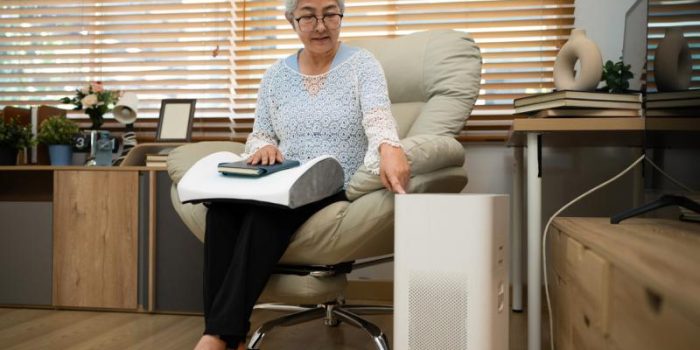
A new study from the United Kingdom found that portable air purifiers didn’t prevent respiratory infections in nursing home residents.
British researchers launched the randomized controlled trial of more than 1,100 older adults from September 2021 to May 2024. Researchers compared bouts of winter respiratory infections in 48 nursing homes given air purifiers and 47 facilities without the devices.
“We found no evidence that HEPA filters reduced resident winter respiratory infection episodes, other infections, antibiotic use, or staff absenteeism,” authors wrote in the paper, published this week in JAMA Internal Medicine. “Care homes should continue to adhere to nationally recommended prevention measures to control respiratory and other infections.”
An extremely vulnerable population
Nursing home residents were extremely vulnerable during the pandemic.
People living in long-term care facilities made up nearly half of all deaths from COVID-19 in 2020. Even as vaccinations rolled out, nursing home residents continued to be vulnerable, accounting for nearly one in four COVID-19 deaths.
Study authors said they launched their study because “the need to reduce infection transmission in that setting was becoming a priority,” first author Alastair Hay, MD, told CIDRAP News.
Researchers persuaded nursing homes to set up the HEPA filters and record any respiratory illness symptoms in residents.
But given the stress that nursing homes were facing in 2021, employees agreed to participate in the research only if it placed “no further burden on staff,” said Hay, a professor of primary care in the Centre for Academic Primary Care Infection Group at the University of Bristol.
Hay described the study as a “pragmatic clinical trial,” conducted under less-than-ideal conditions, “without research staff visiting the sites.” Interviews were largely conducted by phone or video conferencing.
The trial’s “main advantage is that it gives a reproducible estimate of how effective the HEPA filters are likely to be if they are used in ‘real-world’ care homes, with all the inherent difficulties care homes have in ensuring equipment is working,” said Hay.
Air filters need to be turned on to work
Some air quality scientists say the study had numerous flaws.
Air purifiers only work if they’re turned on, said Joseph Allen, MD, a professor of exposure assessment science at the Harvard T.H. Chan School of Public Health, who was not involved in the new study. Based on information in the study, he said, it’s not clear how often the devices were actually used.
In a press release about the study, the University of Bristol wrote that “there were high levels of compliance, with care home managers and residents following the manufacturer’s instructions for air filter set up, location and use.”
But in the study, authors acknowledged, “there was low intervention adherence.”
Linsey Marr, PhD, a professor of civil and environmental engineering at Virginia Tech who wasn’t involved in the new research, said she interprets that statement to mean, “in many cases, the filters were not turned on.”
Researchers listed nursing homes as “compliant” with the study protocol if HEPA filters were in use at least 20% of the time. But that’s a very low bar, Allen said.
“It is possible that the devices were on for only one-fifth of the time,” Allen said.
In the study, authors wrote that HEPA units were mostly turned to the lowest setting to reduce noise, at the request of nursing home staff. “That isn’t going to run that much air through,” said Lisa Brosseau, ScD, CIH, a research consultant at the Center for Infectious Disease Research and Policy (CIDRAP), which publishes CIDRAP News. “But it’s quieter and people are going to be able to stand it.”
Nursing home staff also told researchers that residents, many of whom had dementia, sometimes moved or tampered with the air purifiers.
One resident urinated into the air purifier, according to a companion article published in PLOS One. Another resident put the air purifier on his windowsill. Staff told researchers that another resident “goes around” and turns off the air purifier nearest him “because he doesn’t like the electricity being spent.”
Air filters may have been too small
The study fails to provide basic information that aerosol scientists use to measure air flow, such as the sizes of the bedrooms and communal rooms, Marr said.
But from the data provided, the researchers appear to have used HEPA filters that were much smaller than recommended, Allen noted. Filters need to be large enough to clean all the air in a room.
“It’s obvious that if you use a unit that’s too small, it’s not going to work,” Allen said.
Based on limited information in the paper, Allen and Marr independently calculated that the air purifiers were changing out the air in rooms once or twice an hour. That’s far below standards from the Centers for Disease Control and Prevention, which recommends five air changes an hour.
Air quality experts would have been aware of these standards, Allen said. The study includes no mention of consulting air quality scientists.
Given these limitations, “I’m not surprised by the results” failing to find a benefit from HEPA filters, Marr said.
The study also doesn’t provide information about where air purifiers were placed in common rooms or bedrooms. It’s important to position HEPA filters where they will have the greatest effect, Brosseau said.
“If you stick the filter in the corner, it’s going to clean the air in that corner really well,” said Brosseau, who was not involved in the new study.
“If you really, really want to do a good job of removing particles from the air around somebody who’s sick in a room, you need to have what we call local exhaust ventilation, and that means the air cleaner has to be right next to you,” she added.
A good place to position an air filter, for example, would be between the bed of nursing home resident and the chair where a visitor sits while talking.
Misleading conclusions
Hay said his team considered visiting nursing homes to see if the air filters were being used, but decided against it, given the risk of transmitting COVID-19.
Asking nursing home staff to help measure air quality “could have resulted in care homes and residents deciding they did not want to endure the intervention and withdrawing” from the study.
Given the limitations of the study, Allen said authors should have tempered their conclusions.
“The biggest problem is that the conclusion doesn’t match the data.” Allen said. “If you look strictly at the data, the conclusion is a small HEPA filter that’s turned off doesn’t work.”